
Table of Contents
Introduction
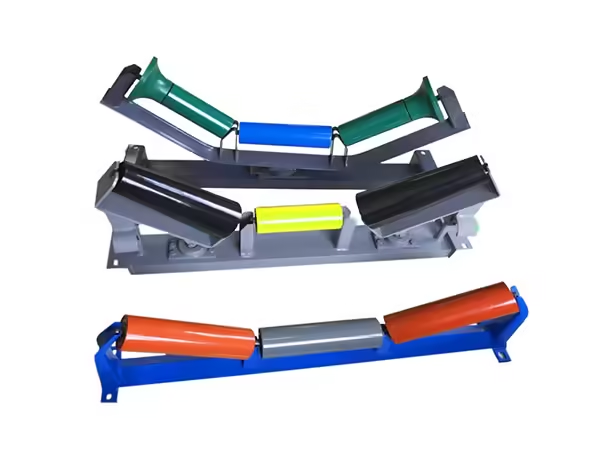
Roller conveyor rollers may look like simple cylindrical components, but their performance depends on a carefully balanced combination of geometry, material, shaft design, bearings, surface condition, spacing, and installation accuracy. When these factors work together, products can move across a conveyor with stable support and predictable motion. When they do not, the same conveyor may experience uneven movement, unnecessary resistance, vibration, product instability, or repeated maintenance.
Unlike belt conveyor idlers, roller conveyor rollers normally interact directly with the products being transported. Boxes, containers, panels, packaged components, and other unit loads may rest on several rollers at the same time, which means the roller arrangement becomes the conveying surface itself. The condition of each roller therefore influences how smoothly the load transfers from one support point to the next.
Choosing the right configuration requires more than matching an existing roller diameter. Product dimensions, bottom geometry, load distribution, conveyor width, roller spacing, shaft mounting, bearing behavior, operating environment, and driven or non-driven operation all influence the final specification.
For industrial material handling, the most reliable approach is to treat every roller as part of a complete conveying system rather than as an isolated replacement component. This article explains how roller conveyor rollers work, which design factors influence their performance, how manufacturing accuracy affects finished roller quality, and what information should be considered when specifying rollers for stable long-term operation.
How Roller Conveyor Rollers Support Material Movement
A conveyor system uses mechanical components to transport materials between locations, but different conveyor designs create that movement in different ways. In a roller conveyor, the load is supported directly by a series of cylindrical rollers rather than by a continuous belt.
This direct contact changes the engineering requirements considerably.
When a box moves along the conveyor, its weight is distributed across the rollers positioned beneath it. As the box advances, one roller leaves the supporting area while another begins carrying part of the load. This transfer happens repeatedly throughout the conveyor.
For smooth movement, the product needs sufficient support during every transition.
If roller spacing is too wide relative to the product length, the load may become unstable between support points. If the product base is irregular, flexible, or too small for the spacing, movement can become less predictable even when individual rollers are mechanically sound.
This is why roller conveyor rollers should always be selected in relation to the product being transported.
Product Geometry Comes Before Roller Diameter
A common equipment-selection mistake is to begin with roller diameter.
Diameter matters, but the transported product should be considered first.
A rigid container with a flat bottom interacts with rollers differently from a flexible package or a component with feet, ribs, recessed areas, or an uneven supporting surface. Even two products of similar weight may require different roller arrangements because their contact geometry is different.
Product length influences roller spacing
As a product travels across the conveyor, several rollers should normally remain available to support it.
The exact arrangement depends on the product and conveyor design, but the underlying principle is straightforward: the load should not repeatedly reach positions where insufficient support causes tipping, hesitation, or unstable movement.
Smaller products generally require closer roller spacing than longer products.
This relationship is more important than simply selecting a strong roller.
Product width influences roller length
The supporting roller needs to provide enough usable width for stable product movement.
A roller that is too short relative to the transported item can reduce lateral support. A roller that is unnecessarily long increases component dimensions without automatically improving the conveying process.
Roller width should therefore reflect both product geometry and conveyor-frame design.
Bottom condition matters
The underside of the product determines where forces actually enter the rollers.
Flat-bottom loads normally distribute contact more predictably. Irregular products may create concentrated contact points.
Before selecting roller conveyor rollers, it is useful to understand not only overall product dimensions but also the surfaces that physically touch the conveyor.
Load Distribution Determines Roller Construction
Conveyor load should not be evaluated only as total product weight.
What matters to an individual roller is the portion of the load that reaches it at a particular moment.
A product supported by several rollers distributes force differently from the same product temporarily supported by fewer rollers during transfer.
This means roller spacing, product length, and load location all affect roller loading.
Evenly distributed loads
A rigid product with a relatively uniform base can spread its load across several rollers.
In this condition, each individual roller carries only part of the total weight.
The actual distribution still depends on roller position, product rigidity, and the geometry of the supporting surface.
Concentrated loads
Components with feet, narrow contact surfaces, or other localized features can create concentrated forces.
A product may appear light overall while still applying relatively high force to one small section of a roller.
This is one reason total weight alone does not provide enough information for roller selection.
Dynamic loading
Products are not always placed onto a conveyor gently.
Additional forces can occur during:
- Loading
- Acceleration
- Stopping
- Accumulation
- Product transfer
- Direction changes
- Contact between adjacent products
Roller construction should reflect real operating behavior rather than only a static load calculation.
Roller Diameter, Wall Thickness, and Shaft Design Work Together
Once the application and load are understood, roller dimensions can be evaluated more meaningfully.
Diameter, shell wall thickness, shaft dimensions, bearing positions, and working length together determine how the roller behaves under load.
They should not be selected independently.
Roller diameter affects structural behavior
A larger diameter changes the geometry of the roller and can influence its resistance to bending, available bearing arrangement, and rotational characteristics.
However, increasing diameter alone does not guarantee a better conveyor.
The correct size needs to fit:
- Product geometry
- Roller spacing
- Conveyor height
- Required load
- Shaft arrangement
- Bearing design
A well-matched roller is more useful than an unnecessarily oversized one.
Wall thickness supports the roller shell
The cylindrical shell transfers product forces toward the bearings and shaft.
Wall thickness therefore contributes to the roller’s structural behavior.
If the shell is unsuitable for the load and roller length, excessive deflection may affect product movement. But simply increasing shell thickness cannot compensate for an inadequate shaft or unsuitable bearing arrangement.
The complete structure must remain balanced.
Shaft design transfers the load to the frame
The shaft connects the rotating roller to the conveyor structure.
Its design is influenced by:
- Roller length
- Applied load
- Bearing position
- Mounting method
- Frame structure
- Shaft-end geometry
The shaft ends also need to match the installation method used by the conveyor frame.
For replacement projects, this detail is particularly important because two rollers with the same shell dimensions may still have completely different mounting interfaces.
Bearings Determine How the Roller Actually Rotates
The visible shell may support the product, but the bearing system determines how the shell rotates around the shaft.
For roller conveyor rollers, stable rotation is essential because every product movement depends on repeated contact with many rotating components.
A roller that rotates with excessive resistance may behave differently from neighboring rollers. Across a long conveyor, inconsistent rotation can result in uneven product movement.
Bearing selection depends on operating conditions
Bearing requirements are influenced by:
- Roller load
- Rotational speed
- Shaft geometry
- Duty cycle
- Operating environment
- Installation alignment
Selecting a bearing solely according to its physical size ignores the way it will actually work inside the roller.
Bearing position matters
The two bearings need to maintain the intended relationship with the roller shell and shaft.
If their positions are inconsistent, the roller may not rotate around the intended axis.
Manufacturing and assembly accuracy therefore become part of bearing performance.
Sealing protects the internal arrangement
Dust, debris, moisture, and other contaminants can influence bearing operation.
A suitable sealing arrangement helps protect internal components while maintaining appropriate rotational behavior.
The required seal design depends on the environment rather than following one universal configuration for every roller.
Gravity and Powered Roller Conveyors Need Different Thinking
Not every roller conveyor moves products in the same way.
Some depend on gravity, while others use powered rollers or external drive systems.
The basic roller structure may look similar, but operating requirements can differ considerably.
Gravity roller conveyors
A gravity conveyor relies on the load moving because of inclination, momentum, or manual force.
Since there is no powered roller forcing the product forward, rotational resistance becomes particularly important.
A roller that turns less freely than neighboring components can influence product movement, especially with lighter loads.
Powered roller conveyors
Powered systems introduce energy into the conveying process.
Depending on the design, rollers may be driven directly or connected through chains, belts, or other drive mechanisms.
The roller then becomes part of both the supporting and power-transmission system.
Additional design considerations can include:
- Drive connection
- Torque transfer
- Roller synchronization
- Accumulation control
- Starts and stops
- Product spacing
A powered roller should therefore not be specified simply by copying the dimensions of a free-running roller.
Roller Spacing Can Change the Entire Conveyor Behavior
Roller spacing is one of the most important system-level parameters in a roller conveyor.
It influences how many rollers support each product, how loads transfer between supports, and how smoothly smaller items move through the system.
Imagine the same product moving across two conveyors.
On the first conveyor, it is supported by several rollers throughout its travel.
On the second, wide spacing allows the product to approach a point where only a small number of rollers support it.
The product itself has not changed.
The individual rollers may even be identical.
Yet the conveying behavior can be noticeably different.
This demonstrates why roller conveyor rollers cannot be evaluated independently from spacing.
Closer spacing provides more frequent support
Closer roller spacing can improve support for shorter products, but it also increases the number of components installed along the conveyor.
The correct spacing should therefore be based on product requirements rather than simply minimizing or maximizing the number of rollers.
Spacing affects load per roller
Changing spacing can also influence load distribution.
If fewer rollers are positioned beneath the same product, each supporting roller may experience a greater portion of the load.
Spacing and roller capacity should therefore be considered together.
Surface Material Changes Product-to-Roller Interaction
The surface of roller conveyor rollers directly contacts the transported product.
This means shell material and surface condition can influence more than mechanical strength.
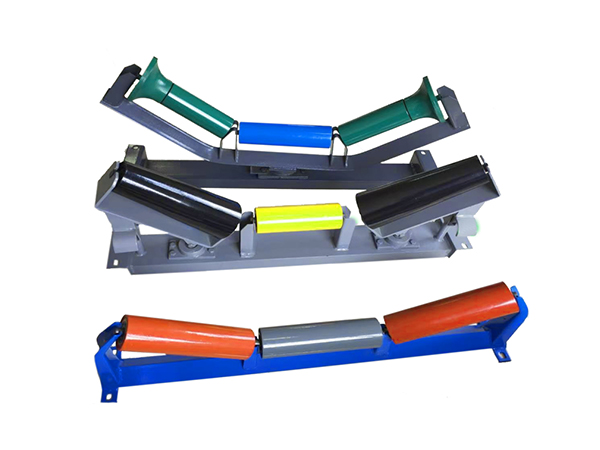
The site’s existing conveyor rollers demonstrate how roller construction can vary according to application, dimensions, material requirements, bearing configuration, and operating conditions.
Steel roller surfaces
Steel rollers are commonly used where structural rigidity and industrial durability are important.
Their suitability depends on the complete construction, including shell thickness, shaft, bearings, and operating environment.
Surface condition also matters where products require smooth contact.
Polymer-based roller options
Certain applications can use polymer-based roller structures or surfaces.
Depending on the material and design, these can offer different characteristics related to component weight, corrosion behavior, noise, or product contact.
However, a material change should always be checked against load, temperature, wear, and dimensional requirements.
Coated or covered surfaces
Some applications require additional surface characteristics.
A covering can modify friction, contact behavior, or product protection.
The surface should solve a defined application problem rather than being selected simply because it appears more specialized.
Manufacturing Accuracy Controls Roller Consistency
When a conveyor contains dozens or hundreds of rollers, manufacturing consistency becomes especially important.
A small difference between two rollers may be difficult to notice individually. If that same difference occurs repeatedly throughout the conveyor, however, it can influence system behavior.
The production of roller conveyor rollers may involve tube preparation, cutting, bearing-related processing, shaft machining, assembly, and final inspection.
Each stage can introduce variation.
Tube cutting establishes roller length
Consistent cutting creates a predictable body dimension for later assembly.
If shell length varies unnecessarily, later bearing or shaft positioning can become more difficult to control.
Shaft machining defines installation geometry
The shaft may include:
- Flats
- Slots
- Grooves
- Threads
- Spring-loaded ends
- Other mounting structures
These features determine how the roller fits into the conveyor frame.
Repeatable machining supports interchangeability when rollers need to be replaced.
Bearing assembly influences rotational geometry
Bearings need to be installed in the intended position relative to the shell and shaft.
Inconsistent bearing-seat position can affect alignment and roller behavior.
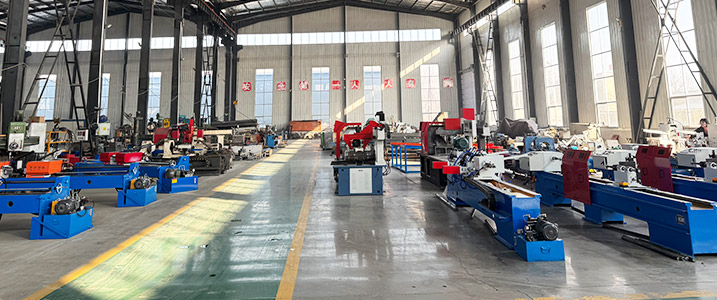
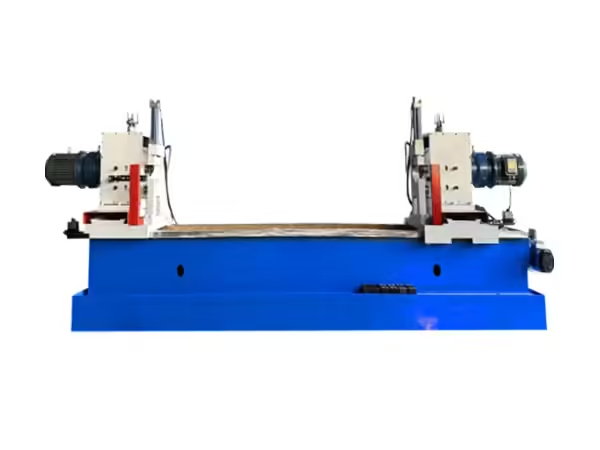
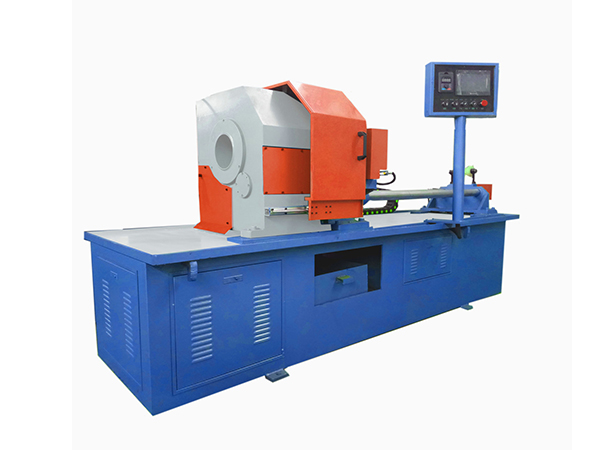
Specialized conveyor roller processing machinery is designed around these recurring operations, including tube preparation, end processing, shaft machining, bearing-related assembly, and other stages involved in roller production.
Final inspection should focus on function
A finished roller can be checked for dimensions, but dimensional inspection alone may not describe operating behavior.
Useful verification can also consider:
- Rotation
- Runout
- Shaft-end geometry
- Bearing position
- Surface condition
- Assembly consistency
For large production quantities, checking repeatability across multiple rollers provides more useful information than inspecting one carefully selected sample.
Runout Has a Direct Relationship With Product Movement
Runout describes how much the roller surface deviates from its intended rotational path as the roller turns.
For roller conveyor rollers, excessive runout can create repeated vertical movement at the contact surface.
A product moving across several such rollers may experience:
- Vibration
- Unstable contact
- Noise
- Uneven movement
Runout can originate from several parts of the manufacturing process.
Possible causes include:
- Tube geometry
- Bearing-seat positioning
- Shaft alignment
- Assembly variation
- Welding distortion where applicable
Controlling runout therefore requires more than final measurement. It requires consistency throughout roller manufacturing.
Long rollers deserve additional attention
As roller length increases, structural and geometric variation can become more significant.
Proper shell selection, shaft support, bearing positioning, and manufacturing alignment become increasingly important.
This is another reason roller dimensions should be evaluated as a complete structure rather than a catalogue diameter.
Conveyor Frame Alignment Is Part of Roller Performance
A correctly manufactured roller can still perform poorly when installed in an incorrectly aligned conveyor.
The supporting frame determines where each roller sits relative to neighboring rollers and the intended conveying path.
If one roller is installed significantly higher, lower, or at a different angle, the transported product may experience unusual movement at that position.
Across multiple misaligned rollers, the effect can become more noticeable.
Roller axes should remain coordinated
For a straight conveyor section, roller axes normally need to maintain the intended geometric relationship.
Installation errors can create:
- Product steering
- Uneven loading
- Additional resistance
- Localized wear
Frame problems can look like roller problems
If rollers repeatedly fail or behave abnormally in the same position, replacing them without checking the frame may not solve the root cause.
The surrounding structure should also be inspected for:
- Deformation
- Incorrect mounting points
- Loose hardware
- Product interference
- Accumulated debris
Roller performance always depends partly on where and how the component is installed.
How to Specify Roller Conveyor Rollers More Effectively
A complete technical specification provides far more useful information than diameter and length alone.
Before choosing a roller configuration, define the actual conveying task.
| Specification Area | Information to Define | Why It Matters |
|---|---|---|
| Product | Dimensions and bottom geometry | Determines contact with rollers |
| Load | Normal and changing load | Influences roller construction |
| Conveyor width | Required support area | Determines roller length |
| Roller spacing | Distance between rollers | Influences product support |
| Roller diameter | Required physical size | Influences structure and rotation |
| Shaft | Dimensions and mounting style | Determines frame compatibility |
| Bearings | Load and operating requirements | Controls roller rotation |
| Surface | Steel, polymer, or special surface | Influences product interaction |
| Drive | Gravity or powered | Changes roller requirements |
| Environment | Dust, moisture, contamination | Influences seals and materials |
| Duty cycle | Operating frequency | Helps define component requirements |
A drawing is particularly useful for replacement rollers because it makes shaft-end geometry and mounting dimensions easier to communicate accurately.
The specification should describe how the roller works, not only what it looks like.
Common Problems Caused by Incorrect Roller Selection
Poor roller performance does not always produce immediate component failure.
Sometimes the first signs appear in product movement.
Products hesitate or stop
Possible causes can include excessive roller resistance, unsuitable spacing, insufficient product contact, or conveyor inclination that does not match the load.
Products vibrate
Roller runout, frame alignment, damaged components, or irregular product geometry may contribute.
Products move sideways
Check roller alignment, frame geometry, product loading position, and whether the product itself has an uneven base.
Rollers wear unevenly
Uneven loading, incorrect mounting, contamination, or concentrated product contact may influence wear.
Bearings repeatedly fail
Repeated bearing problems can indicate contamination, misalignment, unsuitable load conditions, incorrect installation, or a roller specification that does not match the application.
Recurring failures should be investigated as system behavior rather than treated as unrelated component events.
What Makes Reliable Roller Conveyor Rollers Different?
Reliable roller conveyor rollers are not defined by one impressive specification.
Their performance comes from consistency across several relationships.
The shell needs to support the product without unnecessary deformation. The shaft needs to transfer the load into the frame. Bearings need to maintain stable rotation. Seals need to suit the surrounding environment. The surface needs to interact appropriately with the product.
Manufacturing needs to keep these elements aligned.
Installation needs to position the finished roller correctly.
Finally, the conveyor layout needs to provide sufficient roller spacing and support for the actual product.
This is why selecting a roller only by diameter or load rating can miss important application details.
The most useful specification is the one that describes the complete operating condition.
Conclusion
Roller conveyor rollers form the actual supporting surface of many unit-handling conveyor systems. Because products contact the rollers directly, every detail of the roller arrangement can influence movement.
Product geometry determines how the load contacts the conveyor. Roller spacing determines how that load transfers from one support point to another. Diameter, wall thickness, shaft construction, and bearings determine how each roller responds mechanically. Surface material affects product interaction, while runout and manufacturing accuracy influence movement across repeated rollers.
The surrounding conveyor is equally important.
Even accurately manufactured roller conveyor rollers can behave poorly when the frame is misaligned, spacing is unsuitable, or the transported product does not have enough supporting contact.
For reliable specification, begin with the product and the conveying process rather than the roller itself.
Define what is being moved, how it contacts the conveyor, how much load is applied, whether the system is gravity-driven or powered, and what environmental conditions exist. From there, roller dimensions, shafts, bearings, surfaces, spacing, and mounting geometry can be matched to the application.
The best roller is therefore not simply the strongest or largest component.
It is the roller that works predictably with the product, neighboring rollers, conveyor frame, drive method, and operating environment as one complete material-handling system.
FAQ
What are roller conveyor rollers used for?
Roller conveyor rollers directly support products as they move through a conveyor system. Boxes, containers, panels, and other unit loads can rest on several rollers at once. Their diameter, spacing, bearings, shaft design, surface, and alignment should match the product and conveying conditions.
How do I choose the correct roller conveyor rollers?
Begin with product dimensions, bottom geometry, normal load, conveyor width, roller spacing, and whether the system is gravity or powered. Then evaluate roller diameter, shell construction, shaft mounting, bearings, sealing, surface material, operating environment, and duty cycle.
How does roller spacing affect a roller conveyor?
Roller spacing determines how many rollers support the product during movement. Wider spacing can reduce support for short or irregular loads and may increase the load carried by individual rollers. The spacing should keep the transported product sufficiently supported as it transfers between adjacent rollers.
Why do bearings matter in roller conveyor rollers?
Bearings allow the roller shell to rotate around the shaft while carrying load. Their behavior affects rotational resistance and movement consistency. Bearing selection and assembly should consider load, speed, shaft geometry, alignment, operating duration, sealing, and surrounding contamination.
What causes roller conveyor rollers to rotate unevenly?
Uneven rotation can result from bearing damage, contamination, excessive sealing resistance, shaft misalignment, poor bearing-seat positioning, roller runout, installation errors, or material buildup. If several rollers develop similar problems, the conveyor environment and frame alignment should also be inspected.
 English
  French
  Spanish