
Table des matières
Introduction
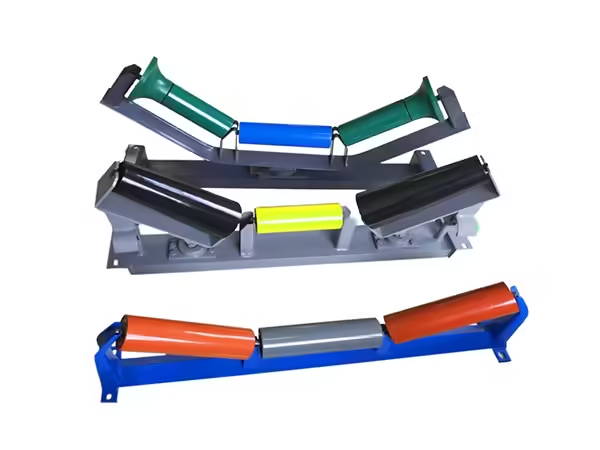
Les rouleaux de convoyeur à rouleaux peuvent ressembler à de simples composants cylindriques, mais leurs performances dépendent d'une combinaison soigneusement équilibrée de géométrie, de matériau, de conception d'arbre, de roulements, d'état de surface, d'espacement et de précision d'installation. Lorsque ces facteurs fonctionnent ensemble, les produits peuvent se déplacer sur un convoyeur avec un support stable et un mouvement prévisible. Lorsqu'ils ne le font pas, le même convoyeur peut subir des mouvements inégaux, une résistance inutile, des vibrations, une instabilité du produit ou un entretien répété.
Contrairement aux rouleaux de convoyeur à bande, les rouleaux de convoyeur à rouleaux interagissent normalement directement avec les produits transportés Les boîtes, conteneurs, panneaux, composants emballés et autres charges unitaires peuvent reposer sur plusieurs rouleaux en même temps, ce qui signifie que l'agencement de rouleaux devient la surface de transport elle-même L'état de chaque rouleau influence donc la fluidité des transferts de charge d'un point de support au suivant.
Choisir la bonne configuration nécessite plus que de correspondre à un diamètre de rouleau existant Les dimensions du produit, la géométrie du fond, la répartition de la charge, la largeur du convoyeur, l'espacement des rouleaux, le montage sur arbre, le comportement du roulement, l'environnement de fonctionnement et le fonctionnement entraîné ou non influent tous sur la spécification finale.
Pour la manutention industrielle des matériaux, l'approche la plus fiable consiste à traiter chaque rouleau comme faisant partie d'un système de transport complet plutôt que comme un composant de remplacement isolé Cet article explique comment fonctionnent les rouleaux de convoyage à rouleaux, quels facteurs de conception influencent leurs performances, comment la précision de fabrication affecte la qualité des rouleaux finis et quelles informations doivent être prises en compte lors de la spécification des rouleaux pour un fonctionnement stable à long terme.
Comment les rouleaux de convoyeur à rouleaux soutiennent le mouvement des matériaux
UN système de convoyage utilise des composants mécaniques pour transporter les matériaux entre les emplacements, mais différentes conceptions de convoyeurs créent ce mouvement de différentes manières Dans un convoyeur à rouleaux, la charge est supportée directement par une série de rouleaux cylindriques plutôt que par une bande continue.
Ce contact direct modifie considérablement les exigences techniques.
Lorsqu'une boîte se déplace le long du convoyeur, son poids est réparti sur les rouleaux positionnés en dessous. Au fur et à mesure que la boîte avance, un rouleau quitte la zone de support tandis qu'un autre commence à transporter une partie de la charge. Ce transfert se produit de manière répétée sur tout le convoyeur.
Pour un mouvement fluide, le produit a besoin d’un support suffisant à chaque transition.
Si l'espacement des rouleaux est trop large par rapport à la longueur du produit, la charge peut devenir instable entre les points d'appui Si la base du produit est irrégulière, flexible ou trop petite pour l'espacement, le mouvement peut devenir moins prévisible même lorsque les rouleaux individuels sont mécaniquement sains.
C'est pourquoi les rouleaux transporteurs à rouleaux doivent toujours être sélectionnés par rapport au produit transporté.
La géométrie du produit arrive avant le diamètre du rouleau
Une erreur courante de sélection d’équipement consiste à commencer par le diamètre du rouleau.
Le diamètre compte, mais le produit transporté doit être considéré en premier.
Un récipient rigide à fond plat interagit avec les rouleaux différemment d'un emballage flexible ou d'un composant avec des pieds, des nervures, des zones en retrait ou une surface de support inégale Même deux produits de poids similaire peuvent nécessiter des dispositions de rouleaux différentes car leur géométrie de contact est différente.
La longueur du produit influence l'espacement des
Lorsqu'un produit traverse le convoyeur, plusieurs rouleaux doivent normalement rester disponibles pour le supporter.
La disposition exacte dépend de la conception du produit et du convoyeur, mais le principe sous-jacent est simple : la charge ne doit pas atteindre de manière répétée des positions où un support insuffisant provoque un basculement, une hésitation ou un mouvement instable.
Les produits plus petits nécessitent généralement un espacement plus étroit des rouleaux que les produits plus longs.
Cette relation est plus importante que la simple sélection d'un rouleau solide.
La largeur du produit influence la longueur du rouleau
Le rouleau de support doit fournir une largeur utilisable suffisante pour un mouvement stable du produit.
Un rouleau trop court par rapport à l'article transporté peut réduire le support latéral Un rouleau inutilement long augmente les dimensions des composants sans améliorer automatiquement le processus de transport.
La largeur du rouleau doit donc refléter à la fois la géométrie du produit et la conception du châssis du convoyeur.
L’état inférieur compte
Le dessous du produit détermine où les forces pénètrent réellement dans les rouleaux.
Les charges à fond plat répartissent normalement le contact de manière plus prévisible Les produits irréguliers peuvent créer des points de contact concentrés.
Avant de sélectionner les rouleaux de convoyage à rouleaux, il est utile de comprendre non seulement les dimensions globales du produit mais également les surfaces qui touchent physiquement le convoyeur.
La répartition de la charge détermine la construction du rouleau
La charge du convoyeur ne doit pas être évaluée uniquement en tant que poids total du produit.
Ce qui importe à un rouleau individuel, c'est la partie de la charge qui l'atteint à un moment particulier.
Un produit supporté par plusieurs rouleaux répartit la force différemment du même produit temporairement soutenu par moins de rouleaux pendant le transfert.
Cela signifie que l'espacement des rouleaux, la longueur du produit et l'emplacement de la charge affectent tous le chargement des rouleaux.
Charges uniformément réparties
Un produit rigide à base relativement uniforme peut répartir sa charge sur plusieurs rouleaux.
Dans cette condition, chaque rouleau individuel ne porte qu'une partie du poids total.
La répartition réelle dépend toujours de la position du rouleau, de la rigidité du produit et de la géométrie de la surface de support.
Charges concentrées
Les composants dotés de pieds, de surfaces de contact étroites ou d'autres caractéristiques localisées peuvent créer des forces concentrées.
Un produit peut paraître léger dans l’ensemble tout en appliquant une force relativement élevée à une petite section d’un rouleau.
C'est l'une des raisons pour lesquelles le poids total à lui seul ne fournit pas suffisamment d'informations pour la sélection des rouleaux.
Chargement dynamique
Les produits ne sont pas toujours placés doucement sur un convoyeur.
Des forces supplémentaires peuvent se produire pendant :
- Chargement
- Accélération
- Arrêt
- Accumulation
- Transfert de produits
- Changements de direction
- Contact entre produits adjacents
La construction des rouleaux doit refléter un comportement opérationnel réel plutôt qu'un simple calcul de charge statique.
Le diamètre du rouleau, l'épaisseur du mur et la conception de l'arbre fonctionnent ensemble
Une fois l’application et la charge comprises, les dimensions des rouleaux peuvent être évaluées de manière plus significative.
Le diamètre, l'épaisseur de la paroi de la coque, les dimensions de l'arbre, les positions des roulements et la longueur de travail déterminent ensemble le comportement du rouleau sous charge.
Ils ne doivent pas être sélectionnés indépendamment.
Le diamètre du rouleau affecte le comportement structurel
Un diamètre plus grand modifie la géométrie du rouleau et peut influencer sa résistance à la flexion, la disposition des roulements disponibles et les caractéristiques de rotation.
Cependant, l'augmentation du diamètre ne garantit pas à elle seule un meilleur convoyeur.
La taille correcte doit s'adapter :
- Géométrie du produit
- Espacement des rouleaux
- Hauteur du convoyeur
- Charge requise
- Disposition d'arbre
- Conception du roulement
Un rouleau bien assorti est plus utile qu'un rouleau inutilement surdimensionné.
L'épaisseur de paroi supporte la coque du rouleau
La coque cylindrique transfère les forces du produit vers les roulements et l'arbre.
L'épaisseur de paroi contribue donc au comportement structural du rouleau.
Si la coque est inadaptée à la charge et à la longueur du rouleau, une déviation excessive peut affecter le mouvement du produit. Mais la simple augmentation de l'épaisseur de la coque ne peut pas compenser un arbre inadéquat ou une disposition de roulement inadaptée.
La structure complète doit rester équilibrée.
La conception de l'arbre transfère la charge au châssis
L'arbre relie le rouleau rotatif à la structure du convoyeur.
Sa conception est influencée par :
- Longueur du rouleau
- Charge appliquée
- Position de roulement
- Méthode de montage
- Structure du cadre
- Géométrie d'extrémité d'arbre
Les extrémités de l'arbre doivent également correspondre à la méthode d'installation utilisée par le châssis du convoyeur.
Pour les projets de remplacement, ce détail est particulièrement important car deux rouleaux ayant les mêmes dimensions de coque peuvent encore avoir des interfaces de montage complètement différentes.
Les roulements déterminent la façon dont le rouleau tourne réellement
La coque visible peut supporter le produit, mais le système de roulement détermine la façon dont la coque tourne autour de l'arbre.
Pour les rouleaux de convoyeur à rouleaux, une rotation stable est essentielle car chaque mouvement de produit dépend d'un contact répété avec de nombreux composants rotatifs.
Un rouleau qui tourne avec une résistance excessive peut se comporter différemment des rouleaux voisins Sur un long convoyeur, une rotation incohérente peut entraîner un mouvement inégal du produit.
La sélection du roulement dépend des conditions de fonctionnement
Les exigences en matière de roulements sont influencées par :
- Charge à rouleaux
- Vitesse de rotation
- Géométrie d'arbre
- Cycle de service
- Environnement opérationnel
- Alignement d'installation
La sélection d'un roulement uniquement en fonction de sa taille physique ignore la manière dont il fonctionnera réellement à l'intérieur du rouleau.
La position du roulement compte
Les deux roulements doivent maintenir la relation prévue avec la coque du rouleau et l'arbre.
Si leurs positions sont incohérentes, le rouleau peut ne pas tourner autour de l'axe prévu.
La précision de fabrication et d'assemblage devient donc une partie des performances des roulements.
L'étanchéité protège l'agencement interne
La poussière, les débris, l'humidité et d'autres contaminants peuvent influencer le fonctionnement du roulement.
Un agencement d'étanchéité approprié permet de protéger les composants internes tout en conservant un comportement de rotation approprié.
La conception requise du joint dépend de l'environnement plutôt que de suivre une configuration universelle pour chaque rouleau.
Les convoyeurs à rouleaux gravitaires et motorisés nécessitent une réflexion différente
Tous les convoyeurs à rouleaux ne déplacent pas les produits de la même manière.
Certains dépendent de la gravité, tandis que d'autres utilisent des rouleaux motorisés ou des systèmes d'entraînement externes.
La structure de base du rouleau peut ressembler, mais les exigences de fonctionnement peuvent différer considérablement.
Convoyeurs à rouleaux gravitaires
Un convoyeur gravitaire repose sur le déplacement de la charge en raison de l'inclinaison, de l'élan ou de la force manuelle.
Puisqu’il n’y a pas de rouleau motorisé forçant le produit vers l’avant, la résistance à la rotation devient particulièrement importante.
Un rouleau qui tourne moins librement que les composants voisins peut influencer le mouvement du produit, en particulier avec des charges plus légères.
Convoyeurs à rouleaux motorisés
Les systèmes motorisés introduisent de l'énergie dans le processus de transport.
Selon la conception, les rouleaux peuvent être entraînés directement ou reliés par des chaînes, des courroies ou d'autres mécanismes d'entraînement.
Le rouleau fait alors partie à la fois du système de support et du système de transmission de puissance.
Des considérations de conception supplémentaires peuvent inclure :
- Connexion d'entraînement
- Transfert de couple
- Synchronisation des rouleaux
- Contrôle de l'accumulation
- Démarre et s'arrête
- Espacement produits
Un rouleau motorisé ne doit donc pas être spécifié simplement en copiant les dimensions d'un rouleau libre.
L'espacement des rouleaux peut modifier le comportement de l'ensemble du convoyeur
L'espacement des rouleaux est l'un des paramètres les plus importants au niveau du système dans un convoyeur à rouleaux.
Cela influence le nombre de rouleaux qui soutiennent chaque produit, la manière dont les charges se transfèrent entre les supports et la fluidité avec laquelle les petits objets se déplacent dans le système.
Imaginez le même produit se déplaçant sur deux convoyeurs.
Sur le premier convoyeur, il est supporté par plusieurs rouleaux tout au long de sa course.
Sur le second, un écartement large permet au produit de se rapprocher d'un point où seul un petit nombre de rouleaux le supportent.
Le produit lui-même n'a pas changé.
Les rouleaux individuels peuvent même être identiques.
Pourtant, le comportement de transport peut être sensiblement différent.
Cela démontre pourquoi les rouleaux transporteurs à rouleaux ne peuvent pas être évalués indépendamment de l'espacement.
Un espacement plus étroit fournit un support plus fréquent
Un espacement plus étroit des rouleaux peut améliorer le support des produits plus courts, mais il augmente également le nombre de composants installés le long du convoyeur.
L'espacement correct devrait donc être basé sur les exigences du produit plutôt que de simplement minimiser ou maximiser le nombre de rouleaux.
L'espacement affecte la charge par rouleau
Le changement d'espacement peut également influencer la répartition de la charge.
Si moins de rouleaux sont positionnés sous le même produit, chaque rouleau de support peut subir une plus grande partie de la charge.
L'espacement et la capacité des rouleaux doivent donc être considérés ensemble.
Le matériau de surface modifie l'interaction produit-rouleur
La surface des rouleaux transporteurs à rouleaux entre directement en contact avec le produit transporté.
Cela signifie que le matériau de la coque et l’état de la surface peuvent influencer plus que la résistance mécanique.
Le site existe rouleaux de convoyeur démontrer comment la construction du rouleau peut varier en fonction de l'application, des dimensions, des exigences en matière de matériaux, de la configuration du roulement et des conditions de fonctionnement.
Surfaces de rouleaux en acier
Les rouleaux en acier sont couramment utilisés là où la rigidité structurelle et la durabilité industrielle sont importantes.
Leur adéquation dépend de la construction complète, y compris l'épaisseur de la coque, l'arbre, les roulements et l'environnement de fonctionnement.
L'état de surface est également important lorsque les produits nécessitent un contact fluide.
Options de rouleaux à base de polymère
Certaines applications peuvent utiliser des structures ou des surfaces de rouleaux à base de polymère.
Selon le matériau et la conception, ceux-ci peuvent offrir différentes caractéristiques liées au poids du composant, au comportement à la corrosion, au bruit ou au contact du produit.
Cependant, un changement de matériau doit toujours être vérifié par rapport aux exigences de charge, de température, d'usure et de dimensions.
Surfaces revêtues ou recouvertes
Certaines applications nécessitent des caractéristiques de surface supplémentaires.
Un revêtement peut modifier la friction, le comportement de contact ou la protection du produit.
La surface devrait résoudre un problème d'application défini plutôt que d'être sélectionnée simplement parce qu'elle semble plus spécialisée.
Précision de fabrication Contrôle la cohérence du rouleau
Lorsqu'un convoyeur contient des dizaines ou des centaines de rouleaux, la cohérence de la fabrication devient particulièrement importante.
Une petite différence entre deux rouleaux peut être difficile à remarquer individuellement Si cette même différence se produit de manière répétée dans tout le convoyeur, elle peut toutefois influencer le comportement du système.
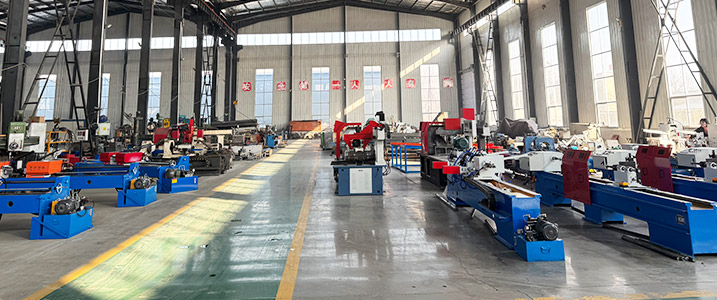
La production de rouleaux de transport à rouleaux peut impliquer la préparation de tubes, la découpe, le traitement lié aux roulements, l'usinage d'arbres, l'assemblage et l'inspection finale.
Chaque étape peut introduire une variation.
La coupe des tubes établit la longueur du rouleau
Une coupe cohérente crée une dimension corporelle prévisible pour un assemblage ultérieur.
Si la longueur de la coque varie inutilement, le positionnement ultérieur du roulement ou de l'arbre peut devenir plus difficile à contrôler.
L'usinage d'arbre définit la géométrie de
L'arbre peut comprendre
- Appartements
- Fentes
- Grottes
- Fils
- Extrémités à ressort
- Autres structures de montage
Ces caractéristiques déterminent la manière dont le rouleau s'insère dans le châssis du convoyeur.
L'usinage répétable prend en charge l'interchangeabilité lorsque les rouleaux doivent être remplacés.
L'assemblage du roulement influence la géométrie de rotation
Les roulements doivent être installés dans la position prévue par rapport à la coque et à l'arbre.
Une position incohérente du siège du roulement peut affecter l’alignement et le comportement du rouleau.
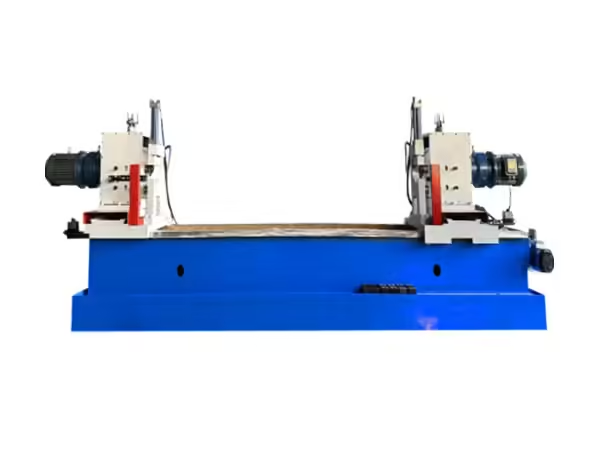
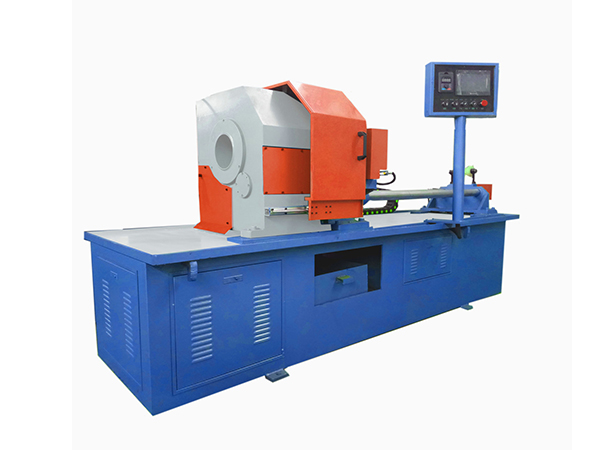
Spécialisé machines de traitement des rouleaux convoyeurs est conçu autour de ces opérations récurrentes, notamment la préparation des tubes, le traitement final, l'usinage de l'arbre, l'assemblage lié aux roulements et d'autres étapes impliquées dans la production de rouleaux.
L'inspection finale devrait se concentrer sur la fonction
Un rouleau fini peut être vérifié pour les dimensions, mais l'inspection dimensionnelle à elle seule peut ne pas décrire le comportement de fonctionnement.
Une vérification utile peut également envisager
- Rotation
- Épuisement
- Géométrie d'extrémité d'arbre
- Position de roulement
- État de surface
- Cohérence d'assemblage
Pour les grandes quantités de production, la vérification de la répétabilité sur plusieurs rouleaux fournit des informations plus utiles que l’inspection d’un échantillon soigneusement sélectionné.
Runout a une relation directe avec le mouvement des produits
Runout décrit dans quelle mesure la surface du rouleau s'écarte de son chemin de rotation prévu lorsque le rouleau tourne.
Pour les rouleaux de convoyeur à rouleaux, un écoulement excessif peut créer un mouvement vertical répété au niveau de la surface de contact.
Un produit se déplaçant sur plusieurs de ces rouleaux peut ressentir :
- Vibration
- Contact instable
- Bruit
- Mouvement inégal
Le faux-rond peut provenir de plusieurs parties du processus de fabrication.
Les causes possibles comprennent :
- Géométrie du tube
- Positionnement du siège du roulement
- Alignement des arbres
- Variation d'assemblage
- Distorsion de soudage le cas échéant
Le contrôle du faux-rond nécessite donc plus qu'une mesure finale Il nécessite une cohérence tout au long de la fabrication des rouleaux.
Les longs rouleaux méritent une attention supplémentaire
À mesure que la longueur du rouleau augmente, les variations structurelles et géométriques peuvent devenir plus importantes.
Une sélection appropriée de la coque, le support de l'arbre, le positionnement des roulements et l'alignement de la fabrication deviennent de plus en plus importants.
C'est une autre raison pour laquelle les dimensions des rouleaux doivent être évaluées comme une structure complète plutôt que comme un diamètre de catalogue.
L'alignement du châssis du convoyeur fait partie des performances des rouleaux
Un rouleau correctement fabriqué peut encore fonctionner mal lorsqu'il est installé dans un convoyeur mal aligné.
Le cadre de support détermine l'endroit où se trouve chaque rouleau par rapport aux rouleaux voisins et le chemin de transport prévu.
Si un rouleau est installé nettement plus haut, plus bas ou sous un angle différent, le produit transporté peut subir un mouvement inhabituel à cette position.
Sur plusieurs rouleaux mal alignés, l’effet peut devenir plus visible.
Les axes de roulage doivent rester coordonnés
Pour une section de convoyeur droite, les axes des rouleaux doivent normalement maintenir la relation géométrique prévue.
Les erreurs d'installation peuvent créer :
- Direction du produit
- Chargement inégal
- Résistance supplémentaire
- Usure localisée
Les problèmes de cadre peuvent ressembler à des problèmes de rouleau
Si les rouleaux tombent en panne à plusieurs reprises ou se comportent anormalement dans la même position, leur remplacement sans vérifier le cadre peut ne pas résoudre la cause profonde.
La structure environnante doit également être inspectée pour :
- Déformation
- Points de montage incorrects
- Matériel lâche
- Interférence du produit
- Débris accumulés
Les performances du rouleau dépendent toujours en partie de l'endroit et de la manière dont le composant est installé.
Comment spécifier les rouleaux de convoyeur à rouleaux plus efficacement
Une spécification technique complète fournit des informations bien plus utiles que le diamètre et la longueur seuls.
Avant de choisir une configuration de rouleau, définissez la tâche de transport réelle.
| Zone de spécification | Informations à définir | Pourquoi c'est important |
|---|---|---|
| Produit | Dimensions et géométrie du fond | Détermine le contact avec les rouleaux |
| Charger | Charge normale et changeante | Influence la construction de rouleaux |
| Largeur du convoyeur | Zone d'assistance requise | Détermine la longueur du rouleau |
| Espacement des rouleaux | Distance entre les rouleaux | Influence le support produit |
| Diamètre du rouleau | Taille physique requise | Influence la structure et la rotation |
| Arbre | Dimensions et style de montage | Détermine la compatibilité des trames |
| Roulements | Exigences de charge et de fonctionnement | Contrôle la rotation des rouleaux |
| Surface | Acier, polymère ou surface spéciale | Influence l'interaction du produit |
| Conduire | Gravité ou motorisé | Modifie les exigences en matière de rouleaux |
| Environnement | Poussière, humidité, contamination | Influence les joints et les matériaux |
| Cycle de service | Fréquence d'exploitation | Aide à définir les exigences relatives aux composants |
Un dessin est particulièrement utile pour les rouleaux de remplacement car il facilite la communication précise de la géométrie de l'extrémité de l'arbre et des dimensions de montage.
La spécification doit décrire le fonctionnement du rouleau, et pas seulement à quoi il ressemble.
Problèmes courants causés par une sélection incorrecte des rouleaux
Les mauvaises performances du rouleau ne produisent pas toujours une défaillance immédiate du composant.
Parfois, les premiers signes apparaissent dans le mouvement du produit.
Les produits hésitent ou s'arrêtent
Les causes possibles peuvent inclure une résistance excessive des rouleaux, un espacement inapproprié, un contact insuffisant avec le produit ou une inclinaison du convoyeur qui ne correspond pas à la charge.
Produits vibre
Le voile du rouleau, l'alignement du cadre, les composants endommagés ou la géométrie irrégulière du produit peuvent y contribuer.
Les produits se déplacent latéralement
Vérifiez l'alignement des rouleaux, la géométrie du cadre, la position de chargement du produit et si le produit lui-même a une base inégale.
Les rouleaux s'usent de manière inégale
Un chargement inégal, un montage incorrect, une contamination ou un contact concentré avec le produit peuvent influencer l'usure.
Les roulements échouent à plusieurs reprises
Des problèmes de roulements répétés peuvent indiquer une contamination, un désalignement, des conditions de charge inappropriées, une installation incorrecte ou une spécification de rouleau qui ne correspond pas à l'application.
Les défaillances récurrentes doivent être étudiées comme un comportement du système plutôt que traitées comme des événements composants non liés.
Qu’est-ce qui différencie les rouleaux de convoyeur à rouleaux fiables ?
Les rouleaux de convoyeur à rouleaux fiables ne sont pas définis par une spécification impressionnante.
Leur performance vient de la cohérence à travers plusieurs relations.
La coque doit supporter le produit sans déformation inutile L'arbre doit transférer la charge dans le cadre Les roulements doivent maintenir une rotation stable Les joints doivent s'adapter à l'environnement. La surface doit interagir de manière appropriée avec le produit.
La fabrication doit maintenir ces éléments alignés.
L'installation doit positionner correctement le rouleau fini.
Enfin, la disposition du convoyeur doit fournir un espacement des rouleaux et un support suffisants pour le produit lui-même.
C'est pourquoi la sélection d'un rouleau uniquement par diamètre ou par indice de charge peut manquer des détails importants sur l'application.
La spécification la plus utile est celle qui décrit la condition complète de fonctionnement.
Conclusion
Les rouleaux de convoyage à rouleaux forment la surface d'appui réelle de nombreux systèmes de convoyage à manutention unitaire Étant donné que les produits entrent en contact directement avec les rouleaux, chaque détail de l'agencement à rouleaux peut influencer le mouvement.
La géométrie du produit détermine la façon dont la charge entre en contact avec le convoyeur L'espacement des rouleaux détermine la façon dont cette charge se transfère d'un point de support à un autre Le diamètre, l'épaisseur de la paroi, la construction de l'arbre et les roulements déterminent la façon dont chaque matériau de surface affecte l'interaction du produit, tandis que le voile et la précision de fabrication influencent le mouvement à travers les rouleaux répétés.
Le convoyeur environnant est tout aussi important.
Même les rouleaux de convoyeur à rouleaux fabriqués avec précision peuvent se comporter mal lorsque le cadre est mal aligné, que l'espacement n'est pas approprié ou que le produit transporté n'a pas suffisamment de contact de support.
Pour des spécifications fiables, commencez par le produit et le processus de transport plutôt que par le rouleau lui-même.
Définissez ce qui est déplacé, comment il entre en contact avec le convoyeur, quelle charge est appliquée, si le système est entraîné par gravité ou alimenté, et quelles conditions environnementales existent À partir de là, les dimensions des rouleaux, les arbres, les roulements, les surfaces, l'espacement et la géométrie de montage peuvent être adaptés à l'application.
Le meilleur rouleau n'est donc pas simplement le composant le plus fort ou le plus grand.
C'est le rouleau qui fonctionne de manière prévisible avec le produit, les rouleaux voisins, le châssis du convoyeur, la méthode d'entraînement et l'environnement de fonctionnement comme un système complet de manutention des matériaux.
FAQ
À quoi servent les rouleaux de convoyeurs à rouleaux ?
Les rouleaux de convoyage à rouleaux supportent directement les produits lorsqu'ils se déplacent dans un système de convoyage Les boîtes, conteneurs, panneaux et autres charges unitaires peuvent reposer sur plusieurs rouleaux à la fois Leur diamètre, leur espacement, leurs roulements, la conception de l'arbre, la surface et l'alignement doivent correspondre au produit et aux conditions de convoyage.
Comment choisir les bons rouleaux de convoyeur à rouleaux ?
Commencez par les dimensions du produit, la géométrie du fond, la charge normale, la largeur du convoyeur, l'espacement des rouleaux et si le système est gravitaire ou alimenté. Évaluez ensuite le diamètre du rouleau, la construction de la coque, le montage de l'arbre, les roulements, l'étanchéité, le matériau de surface, l'environnement de fonctionnement et le rapport cyclique.
Comment l'espacement des rouleaux affecte-t-il un convoyeur
L'espacement des rouleaux détermine le nombre de rouleaux qui supportent le produit pendant le mouvement Un espacement plus large peut réduire le support pour les charges courtes ou irrégulières et peut augmenter la charge portée par les rouleaux individuels L'espacement doit maintenir le produit transporté suffisamment soutenu lorsqu'il se transfère entre les rouleaux adjacents.
Pourquoi les roulements comptent-ils dans les rouleaux de convoyeur à rouleaux
Les roulements permettent à la coque du rouleau de tourner autour de l'arbre tout en portant la charge. Leur comportement affecte la résistance à la rotation et la cohérence du mouvement. La sélection et l'assemblage du roulement doivent prendre en compte la charge, la vitesse, la géométrie de l'arbre, l'alignement, la durée de fonctionnement, l'étanchéité et la contamination environnante.
Qu'est-ce qui fait tourner les rouleaux du convoyeur à rouleaux de manière
Une rotation inégale peut résulter de dommages aux roulements, d'une contamination, d'une résistance d'étanchéité excessive, d'un désalignement de l'arbre, d'un mauvais positionnement du siège du roulement, d'un faux-rond des rouleaux, d'erreurs d'installation ou d'une accumulation de matériaux. Si plusieurs rouleaux développent des problèmes similaires, l'environnement du convoyeur et l'alignement du châssis.
 French
  English
  Spanish