
Table of Contents
Introduction
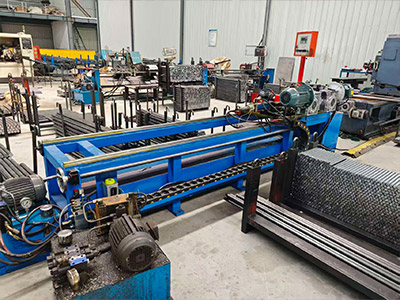
Roll forming machines are widely used in continuous metal processing to shape sheet or strip material into precise, repeatable profiles. By passing the material through a series of carefully designed forming rolls, the process gradually creates the required cross-section while maintaining stable production and dimensional consistency. The performance of a roll forming line depends not only on the rolls themselves, but also on material feeding, tooling design, machine rigidity, drive coordination, cutting accuracy, and automation.
For manufacturers working with metal components, this process offers an efficient way to produce long profiles whose cross-sectional geometry remains largely consistent along their length. Channels, rails, frames, structural sections, and other formed profiles can all rely on the same basic manufacturing principle: instead of forcing the material into its final shape in one operation, the deformation is distributed across several controlled forming stages.
That gradual approach is what gives roll forming its characteristic production stability. However, the finished quality still depends heavily on how well the machine, tooling, material, and process parameters are matched. A poorly designed roll sequence can produce twist or dimensional variation even when the machine itself is structurally strong. Likewise, accurate tooling cannot compensate for unstable feeding, incorrect alignment, or unsuitable raw material.
Understanding how roll forming machines work therefore requires looking at the complete production system rather than viewing each forming roll as an isolated component. The following sections explain how the process develops the profile, what determines finished quality, how automation changes production control, and what manufacturers should consider when planning equipment for continuous metal forming.
How Roll Forming Machines Shape Metal Gradually
The operating principle of roll forming is based on progressive deformation. A metal strip enters the machine in a relatively flat condition and passes through a sequence of roll stations. Each station changes the shape slightly, bringing the material progressively closer to the final profile.
This gradual forming method is important because metal does not respond well when complex geometry is forced into it too quickly. Sharp deformation in one location can create local stress, distortion, uneven material flow, or surface defects. By dividing the required shape change between several stations, roll forming machines allow the material to move toward the final cross-section in a more controlled way.
The first stations usually begin with relatively modest bends. As the strip advances, later stations increase these angles, create secondary features, or stabilize the profile. The final forming stands are often responsible for bringing critical dimensions closer to their required values and correcting small deviations created earlier in the process.
This means that the quality of the final profile is already being determined long before it reaches the last roll stand. If the material enters the machine off-center or the first stations introduce uneven deformation, later stations may struggle to correct the resulting twist or dimensional imbalance. A good forming line therefore treats the entire sequence as one coordinated process.
Why Roll Tooling Determines the Final Profile
The tooling installed on roll forming machines defines how the material changes shape. Each pair of forming rolls has a specific geometric purpose, and the complete roll design determines how deformation is distributed from the first station to the last.
Good tooling design begins with the finished profile. Engineers study the required cross-section, material thickness, bend positions, corner geometry, and dimensional tolerances before deciding how many forming stages are needed. The objective is not simply to reproduce the final shape across multiple rolls. It is to decide how the material should arrive at that shape without creating unnecessary stress or unstable movement.
For a relatively simple open channel, the forming sequence may be straightforward. More complicated profiles with several bends, asymmetric features, or narrow sections require more careful consideration. If too much deformation is concentrated in one station, the metal may pull unevenly across the strip width. If too many corrective stages are added without a clear purpose, the machine becomes more complicated without necessarily improving the result.
Material behavior also affects tooling design. Different grades and thicknesses respond differently to bending and springback. The roll geometry therefore needs to account for how the material behaves after it leaves the contact point, not only how it looks while compressed between the rolls.
This is why experienced roll forming machine design combines mechanical tooling knowledge with practical forming behavior. The final profile is created by the interaction between material, roll geometry, machine alignment, and progressive deformation.
Material Feeding Is the Starting Point of Process Stability
Before the strip reaches the forming rolls, it must enter the line in a controlled and repeatable way. Stable feeding is one of the less visible but highly important aspects of roll forming production.
If material enters the first station at an incorrect lateral position, even accurate roll tooling may produce an asymmetric profile. The problem becomes more serious as the strip continues through subsequent stands because small deviations introduced early can affect the material path through the entire machine.
Feeding systems therefore need to maintain both forward movement and lateral guidance. The line should allow material to move without excessive wandering, sudden tension changes, or uncontrolled movement before forming begins.
Coil-fed systems also need to coordinate the relationship between decoiling and forming speed. The material should reach the machine smoothly rather than being pulled irregularly from the coil. Sudden changes in strip tension can affect material tracking and may also create inconsistency in the forming process.
For this reason, roll forming machines should not be evaluated only by the number of forming stands or their maximum working speed. The stability of the material before the first stand can be just as important as the geometry created by the final one.
Machine Rigidity and Alignment Affect Every Forming Station
A forming line may contain well-designed tooling, but the machine structure still needs to keep that tooling in the correct relationship during production. The roll stands, shafts, bearings, and supporting frame all contribute to the mechanical stability of the process.
When metal passes through a forming station, the rolls apply force to change its shape. Those forces are transferred through the shafts and machine structure. If the system allows unwanted movement, the position of the rolls may change slightly under load, which can affect profile dimensions or consistency.
Alignment is equally important. Roll shafts should maintain the intended relationship with one another, and successive stations should follow the same forming centerline. Small alignment differences can influence strip tracking, profile twist, flange dimensions, or overall symmetry.
This is especially relevant on longer forming lines. The material may pass through many individual stations, so small errors can accumulate. A stable roll forming machine therefore needs to control not only the accuracy of each stand but also the relationship between every stand along the production path.
Good mechanical design also helps simplify adjustment. Operators should be able to correct normal setup deviations without introducing new alignment problems elsewhere in the machine.
Forming Speed Should Follow Process Stability
Production speed is an important consideration, but increasing line speed does not automatically improve manufacturing performance. Roll forming machines work most effectively when feeding, forming, cutting, and downstream handling remain synchronized.
At higher speeds, small process problems can become more visible. Material entering the machine incorrectly has less time to stabilize. Cutting systems must respond more quickly. Finished profiles need to leave the line without creating interruptions or accumulating in unstable positions.
A useful way to evaluate speed is therefore to consider the complete operating cycle rather than only the rotational speed of the forming rolls.
| Production Area | What Needs to Stay Controlled | Effect on Finished Profile |
|---|---|---|
| Material feeding | Strip position and tension | Influences profile symmetry |
| Forming stands | Roll alignment and geometry | Determines cross-section |
| Drive system | Stable synchronized movement | Helps maintain process consistency |
| Cutting | Length positioning | Controls finished component length |
| Product exit | Smooth profile transfer | Prevents handling distortion |
| Changeover | Repeatable setup | Maintains quality between batches |
The best operating speed is the speed at which the complete process remains stable. A machine that operates slightly slower but produces consistent profiles can provide more practical value than a faster line that requires frequent adjustment or creates greater dimensional variation.
Automation Is Changing How Roll Forming Machines Are Controlled
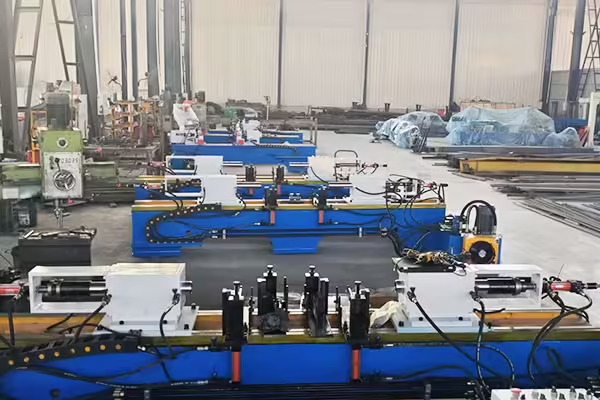
Modern roll forming machines increasingly use automation to manage operations that previously depended heavily on manual adjustment. Programmable controls can coordinate feeding, line speed, length measurement, cutting, and other production functions.
The main value of automation is not simply reducing operator involvement. It is creating a more repeatable production environment.
For example, when length measurement is integrated into the control system, operators do not need to repeatedly determine the cutting point manually. Stored parameters can also make it easier to return to previously used product settings when the line produces several related profiles.
Automation is particularly valuable when it controls operations that would otherwise introduce repeated variation. Positioning, timing, feeding, and cutting are all examples where consistent electronic control can support stable production.
However, automation should be built on a mechanically stable process. Advanced controls cannot permanently correct poorly aligned forming stands or unsuitable tooling. If the material is being deformed incorrectly, increasing the level of automation simply allows that incorrect process to repeat more efficiently.
The strongest roll forming systems therefore combine mechanical accuracy with practical automation rather than treating one as a replacement for the other.
Profile Quality Depends on More Than Width and Height
Finished profiles are often checked using obvious dimensions such as overall width, height, or flange size. These measurements are important, but they do not describe the complete forming result.
Straightness is another major consideration. A profile may have the correct cross-section and still curve gradually along its length. Twist can also develop when deformation is not balanced across the material. In this case, one section of the profile rotates progressively relative to another.
Surface condition deserves attention as well. Because the strip remains in repeated contact with forming rolls, tooling condition and surface finish can influence marks or scratches. Where finished surfaces remain visible in the final application, tooling cleanliness and material handling become more important.
Corner geometry and bend angles also need to remain consistent. If springback is not adequately considered, a bend may relax after leaving the rolls and move away from the intended angle.
These characteristics show why finished profile inspection should not focus on only one or two dimensions. A stable forming process should control the entire geometry that affects how the component will fit, assemble, or function later.
Material Properties Change the Way Forming Behaves
The same roll forming machine can behave differently when the material specification changes. Thickness, strength, surface condition, and mechanical properties all affect how the strip responds to bending.
A thicker material generally requires more force to form than a thinner strip with the same geometry. Higher-strength materials may also show different springback behavior, which changes the relationship between roll geometry and the final profile.
This is why changing raw material without reviewing machine settings can create unexpected dimensional differences. Even when the finished drawing remains unchanged, the process required to reach that geometry may need adjustment.
Manufacturers planning repeated production should therefore define the normal material range rather than treating every sheet or strip specification as automatically interchangeable.
Material consistency also matters within the same production batch. Significant variation in thickness or mechanical behavior can influence forming stability even when the equipment setup remains unchanged.
A well-planned forming process treats material specifications as part of the machine setup rather than as background purchasing information.
Cutting Is Part of the Forming Process, Not an Afterthought
Once the required profile has been formed, it normally needs to be separated into finished lengths. Cutting therefore becomes an important downstream stage in many roll forming machines.
The cutting system needs to maintain the required product length without unnecessarily disturbing the formed profile. If the profile moves during cutting or the cutting operation creates excessive deformation at the end, an otherwise accurate forming process can still produce unacceptable components.
In continuous production, cutting also needs to remain synchronized with line movement. Depending on the machine configuration, cutting may occur while material is moving or after it reaches a defined position.
Length control should therefore be evaluated together with feeding accuracy. If the line feeds inconsistently, the cutting system cannot reliably compensate for every upstream variation.
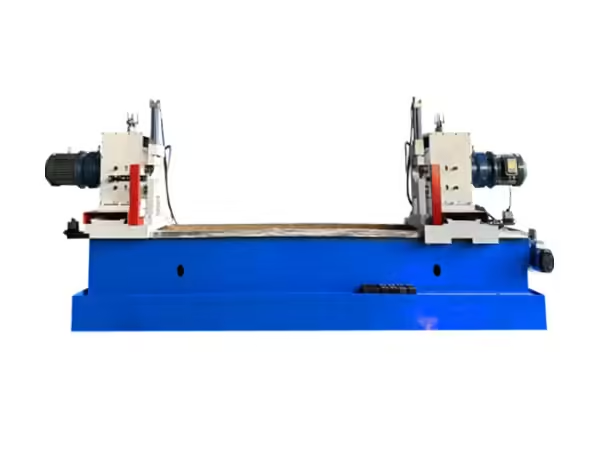
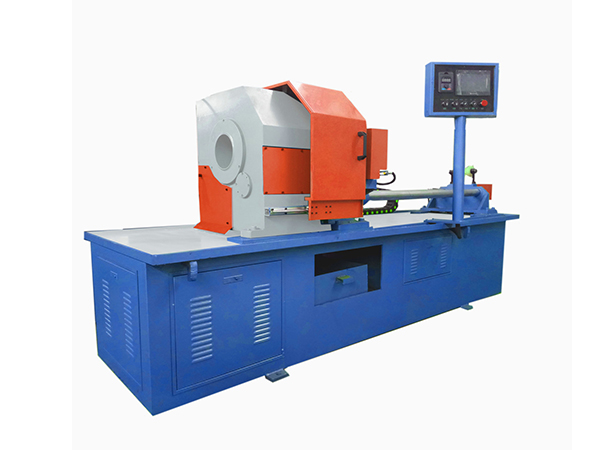
This relationship is similar to other metal-processing production lines. The site’s broader manufacturing and processing machinery also demonstrates how feeding, cutting, positioning, machining, and downstream operations need to work as connected stages rather than independent equipment functions.
The principle applies beyond roll forming: a process is only as stable as the relationship between its individual operations.
Changeover Matters When One Line Produces Several Profiles
Many manufacturers need a forming line that can produce more than one component specification. In this situation, machine flexibility becomes important, but flexibility should be evaluated through the actual changeover process rather than simply through a wide nominal working range.
Changing from one profile to another may require tooling replacement, roll repositioning, guide adjustment, parameter changes, or cutting-system changes. If every adjustment depends heavily on manual measurement, setup consistency can vary between production runs.
A more practical roll forming machine design makes frequently repeated changes understandable and reproducible. Clear roll positions, stored settings, organized tooling, and defined setup procedures can reduce the amount of trial production required after a changeover.
This becomes particularly important when several employees operate the same line. A setup method that works only because one experienced technician remembers a sequence of informal adjustments is difficult to scale.
Flexible manufacturing is therefore not simply the ability to produce many shapes. It is the ability to move between required shapes while maintaining predictable setup and finished quality.
Maintenance Has a Direct Effect on Forming Accuracy
Roll forming machines operate through repeated mechanical contact. Rolls, shafts, bearings, guides, and drive components therefore need regular inspection and maintenance if the machine is expected to maintain the same forming behavior over time.
Tooling wear can gradually change contact conditions. Bearing wear may affect shaft stability. Accumulated debris can influence material guidance. Loose or incorrectly adjusted components may alter alignment.
These changes do not always create immediate machine failure. More often, they appear gradually as profile variation, unusual surface marks, increased adjustment, or unstable material movement.
For that reason, maintenance should include attention to product quality trends rather than only responding when the machine stops operating.
If a profile that previously ran consistently begins to require repeated adjustment, the production team should inspect both tooling and machine condition before simply changing process parameters.
Maintenance accessibility also matters during machine design. Components that require routine inspection should be reasonably accessible so that normal service work does not require extensive disassembly.
Where Roll Forming Fits Within a Broader Metal Manufacturing System
Roll forming machines are highly effective when the required product begins as strip or sheet and needs a continuous cross-section. They are not intended to replace every other metal-processing method.
Some components require cutting. Others need turning, milling, grooving, welding, pressing, or assembly. A complete industrial production environment may therefore contain several different machine types, each selected according to the geometry it needs to create.
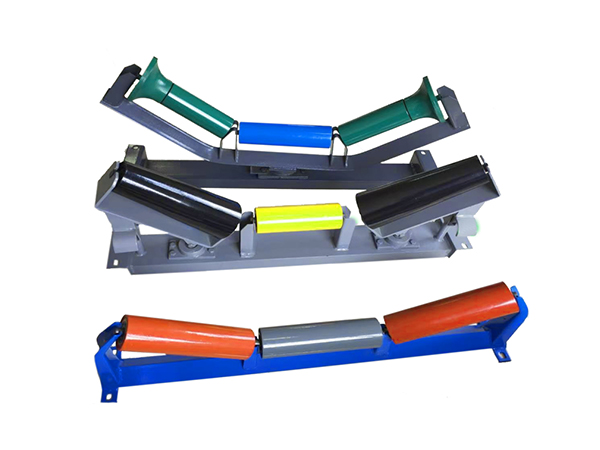
Conveyor roller manufacturing is one useful example of this difference. A roller normally begins with tube and shaft materials rather than a flat metal strip. Its production may require tube cutting, end machining, shaft processing, bearing assembly, and welding. Dedicated conveyor roller processing machinery is therefore designed around those operations instead of continuous profile forming.
The useful lesson is not that one technology is superior to another. It is that the correct process comes from understanding the starting material and finished component.
Roll forming is ideal when progressive deformation creates the required geometry. Machining is more suitable when localized material needs to be removed. Assembly equipment is necessary when several finished components need to be joined into one functional product.
Industrial production becomes more efficient when each process is used for the problem it is designed to solve.
How to Evaluate Roll Forming Machines Before Production
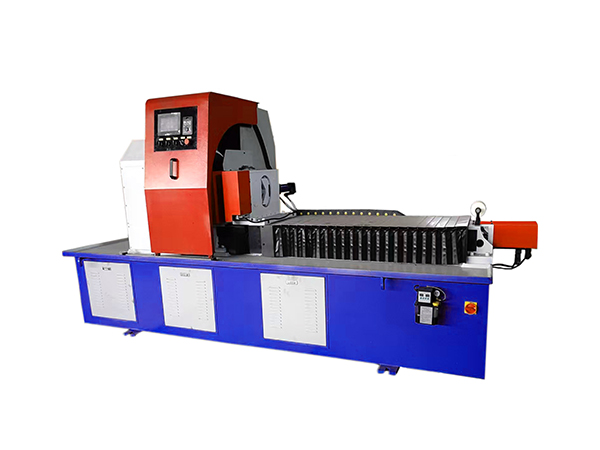
A good equipment evaluation should move beyond headline specifications.
The first consideration is whether the machine can produce the required profile from the intended material. From there, tooling design, forming sequence, structural rigidity, alignment, feeding, drive control, cutting accuracy, and changeover all need to be considered together.
It is also useful to evaluate the machine using representative production conditions rather than only one carefully prepared sample. Several consecutive profiles can reveal whether dimensions remain stable after the process has been running for a period of time.
Different positions along the finished profile should be measured as well. A component can appear correct at one end but gradually change along its length if the line introduces twist or curvature.
Where several product types will be produced, each common changeover should also be tested. The goal is not only to prove that the machine can technically form several profiles, but to understand whether operators can move between them without excessive adjustment.
A strong machine evaluation therefore asks two questions at the same time:
Can the machine create the required geometry?
Can it continue creating that geometry predictably during routine production?
The second question is usually what separates a successful test from a successful manufacturing process.
Conclusion
Roll forming machines create metal profiles through controlled, progressive deformation rather than forcing the final shape in a single operation. Their production value comes from the ability to repeat the same cross-sectional geometry continuously while maintaining dimensional stability across long lengths of material.
Achieving that result depends on more than the forming rolls themselves.
Tooling determines how deformation is distributed. Feeding controls how material enters the line. Machine structure and alignment maintain the relationship between successive forming stands. Drive systems keep movement stable. Automation can reduce repeated positioning and timing variation, while cutting determines whether the continuous profile becomes accurately sized finished components.
Material properties, changeover methods, maintenance, and inspection also influence long-term performance.
For manufacturers considering roll forming machines, the most important step is to define the finished profile and the material from which it will be produced. Once those requirements are clear, the machine can be evaluated according to how effectively it controls the complete forming process.
A reliable roll forming line is not simply a collection of shaped rollers. It is a coordinated manufacturing system in which material, tooling, machine structure, automation, and quality control work together to produce the same geometry repeatedly.
FAQ
What are roll forming machines mainly used for?
Roll forming machines are mainly used to produce long metal profiles with a consistent cross-section. Sheet or strip material passes through multiple forming stands, where the shape is created gradually. Applications depend on profile geometry, material thickness, dimensional requirements, and production conditions.
How do roll forming machines maintain profile accuracy?
Profile accuracy depends on coordinated tooling design, roll alignment, material feeding, machine rigidity, drive stability, and suitable process settings. Each forming stand performs part of the deformation, so errors introduced early in the line can affect later stations and the final profile geometry.
What materials can be processed with roll forming machines?
Roll forming machines can process different metallic sheet and strip materials when tooling and machine capacity are suitable. Material thickness, strength, ductility, surface condition, and springback behavior should be considered because they influence forming force, roll design, and finished dimensions.
Why do roll forming machines use multiple forming stations?
Roll forming machines can process different metallic sheet and strip materials when tooling and machine capacity are suitable. Material thickness, strength, ductility, surface condition, and springback behavior should be considered because they influence forming force, roll design, and finished dimensions.
What should be checked when selecting roll forming machines?
Evaluate profile geometry, raw material, thickness range, tooling design, machine rigidity, alignment, feeding, drive control, cutting method, production stability, changeover, maintenance, and inspection requirements. The machine should demonstrate repeatable profile quality under realistic production conditions.
 English
  French
  Spanish