

Table of Contents
Introduction
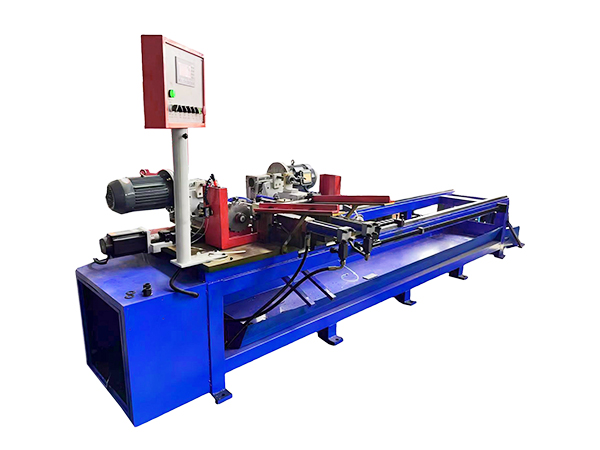
An automatic blunt roller machine is used in conveyor roller manufacturing to prepare roller or shaft ends before later machining, assembly, or installation processes. In this production context, “blunt” refers to creating a controlled flat or finished end rather than leaving the workpiece with an irregular cut surface. The process can also be combined with chamfering, center-hole machining, or other end-preparation operations depending on the structure of the finished roller and the requirements of the following production stage.
Although end processing may appear to be a relatively small part of roller manufacturing, it establishes important dimensional references for later operations. A roller shaft with inconsistent end length, poor end-face geometry, or an incorrectly positioned center hole can create additional adjustment during turning, milling, assembly, or inspection. When large quantities of conveyor rollers are produced, small differences at this early stage can develop into repeated variation across the entire production line.
Automation helps reduce this uncertainty by controlling workpiece feeding, positioning, clamping, simultaneous end processing, and unloading in a repeatable sequence. The value of an automatic blunt roller machine therefore comes not only from reducing manual handling but also from providing a more consistent starting condition for downstream roller manufacturing. To understand whether this equipment is suitable for a production line, it is necessary to examine how end processing works, which dimensions matter, how double-end machining improves production consistency, and how the machine integrates with other conveyor roller manufacturing equipment.
Why Roller End Processing Matters in Conveyor Manufacturing
A conveyor roller is assembled from several components whose dimensions need to remain coordinated. The roller shell, shaft, bearings, bearing housings, seals, and mounting features ultimately need to form one rotating assembly that fits accurately into the conveyor structure. Before these components can be assembled, however, the tube and shaft materials normally pass through several preparation and machining stages.
End processing is important because the end face often becomes a reference for later manufacturing. If the shaft length is inconsistent or the end face is not properly controlled, the position of flats, grooves, threads, bearing-related surfaces, or mounting features may also become more difficult to maintain. A machining process that is accurate relative to an unstable reference cannot guarantee consistent finished components.
An automatic blunt roller machine creates a more predictable end condition before these later processes begin. Rather than relying on manual positioning and separate machining at opposite ends, the workpiece can be located according to a defined datum and processed through a repeatable cycle. This is particularly useful when the same family of roller shafts or roller components is produced continuously.
The principle is closely related to the broader function of a machine tool, where controlled relationships between the tool, workpiece, fixture, and machine movement determine the accuracy of the finished part. In roller manufacturing, good end preparation improves this relationship before more complex machining begins.
What an Automatic Blunt Roller Machine Actually Processes
The main purpose of an automatic blunt roller machine is to create controlled geometry at one or both ends of a cylindrical workpiece. Depending on machine configuration and production requirements, this can include flat-end machining, chamfering, center-hole preparation, or a combination of these operations.
Flat-end machining establishes the finished length and creates a cleaner reference surface. A cut shaft or tube may already be close to its required length, but the original cut surface may contain small dimensional differences or irregularities. End facing removes controlled material so that the final end position becomes more consistent.
Chamfering prepares the edge between the end face and outside diameter. A controlled chamfer can make later handling or assembly easier and can prevent an excessively sharp edge from remaining after machining. The chamfer also needs to remain consistent because different edge conditions can influence how the component enters another fixture or assembly operation.
Center-hole machining provides a reference for subsequent turning or related shaft-processing operations. When the center hole is accurately positioned relative to the shaft axis, later machining can use that reference to maintain a more stable relationship between opposite shaft features.
These operations are therefore connected. Flat-end machining establishes length, chamfering prepares the edge, and center-hole machining can provide a reference for downstream processing. Combining them within one controlled cycle can reduce unnecessary workpiece transfers between separate machines.
Double-End Processing Improves the Relationship Between Both Sides
A roller shaft normally has functional features at both ends. If the two ends are processed independently, every repositioning step introduces another opportunity for dimensional variation. The operator may remove the workpiece, reverse it, locate it against another stop, clamp it again, and then process the second end. Even when each machining operation is individually accurate, the relationship between the two ends depends on how consistently the shaft is repositioned.
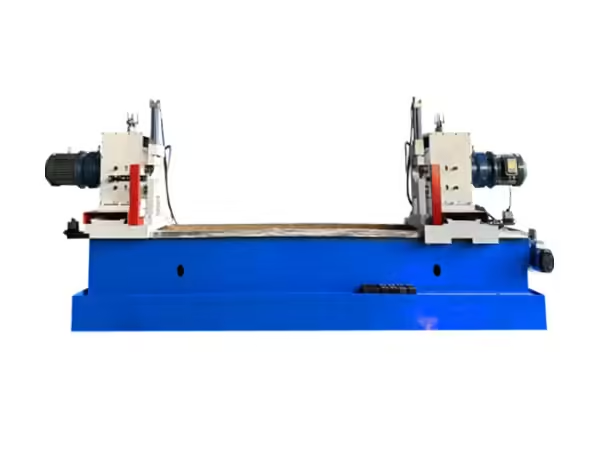
Automatic double-end processing reduces this dependence on repeated manual locating. Once the shaft is positioned and clamped, machining units on both sides can process the workpiece according to the same setup. This makes it easier to control overall length and maintain a more consistent relationship between opposite ends.
The benefit is not simply higher machining speed. From a manufacturing perspective, reducing the number of datum transfers can also reduce variation. Every time a part is removed and located again, fixture contact, operator handling, burrs, surface condition, or small material differences can influence its position.
This is why the conveyor roller processing machinery used in specialized roller production frequently adopts double-end processing concepts. Roller shafts and steel tubes are naturally bilateral components, so processing both ends within a coordinated setup can fit their geometry more effectively than treating each end as an unrelated operation.
Automatic Loading and Positioning Reduce Manual Variation
Automation begins before the cutting tool contacts the workpiece. The shaft or roller component first needs to reach a predictable position inside the machine.
In manual machining, operators may repeatedly place components against mechanical stops and adjust their position by experience. This can be suitable for occasional work, but production consistency becomes more difficult to maintain when hundreds of similar components are processed. Small differences in how operators load, push, or clamp the workpiece can gradually appear in finished dimensions.
Automatic loading systems reduce the number of repeated manual actions. The workpiece can be transferred into the machining position according to a defined sequence, while stops, sensors, or positioning mechanisms confirm that it has reached the required location before the machining cycle begins.
The important point is not that automatic loading completely removes the operator. Its real manufacturing value is that the same locating sequence can be repeated more consistently across multiple workpieces.
Workpiece support is equally important. Long roller shafts should remain sufficiently supported so that their own length does not introduce unstable positioning. An automatic blunt roller machine therefore needs to consider loading, support, centering, and clamping as part of one positioning system rather than focusing only on tool movement.
Clamping Determines Whether Machine Accuracy Reaches the Workpiece
A machine may have accurate slides and cutting tools, but those capabilities have limited value if the workpiece moves during machining. Clamping is the mechanical link between machine accuracy and finished-part accuracy.
For cylindrical roller components, the fixture needs to establish a repeatable location while resisting cutting forces. It should support the shaft or tube without unnecessary deformation and maintain the workpiece centerline in the intended relationship with the cutting units.
Excessive clamping force is not automatically better. If a thin-wall tube or relatively slender shaft is held incorrectly, strong local pressure can change its geometry. The objective is to create stable support rather than simply applying the maximum available force.
Repeatable clamping also matters during size changes. When an automatic blunt roller machine processes several shaft diameters or lengths, adjustments should allow the fixture to maintain a reliable datum throughout the normal working range. If operators need to recreate the locating system manually after every changeover, much of the consistency gained through automation can be lost.
For this reason, fixture design deserves the same attention as spindle power, hydraulic systems, or control interfaces when evaluating roller-processing equipment.
Centerline Control Influences Later Shaft Machining
A roller shaft can contain flats, grooves, threads, bearing surfaces, and other functional features. Many of these dimensions need to maintain a meaningful relationship with the shaft axis.
If center-hole preparation forms part of the automatic blunt roller machine cycle, the center position should remain aligned with the intended workpiece centerline. An incorrectly positioned center reference can affect subsequent turning or machining because later operations may follow the reference established at this stage.
This makes centerline stability one of the most important aspects of end-processing accuracy. Machine structure, fixture positioning, tool alignment, and workpiece straightness can all influence the final result.
Good production control therefore does not focus only on the visible end surface. It also evaluates whether the end-processing operation establishes a useful reference for the next manufacturing stage.
This is particularly important in a multi-machine production line. The output from one machine becomes the input for another. If each operation creates a predictable datum for the next stage, the entire production process becomes easier to control.
How the Machine Fits Into a Conveyor Roller Production Line
An automatic blunt roller machine normally represents one stage within a broader manufacturing process rather than a complete roller production solution by itself. Conveyor rollers require several components to be prepared before final assembly, which means end processing needs to coordinate with cutting, shaft machining, tube processing, bearing assembly, welding, and inspection.
A simplified production sequence may begin with tube and shaft preparation. Raw material is cut to an initial length, after which shaft ends can be faced, chamfered, or center-drilled. The shaft can then move to additional operations such as flat milling, groove machining, or other feature creation. At the same time, the roller tube may undergo end processing before bearing housings and related components are assembled.
The exact sequence depends on roller construction, but the key principle remains the same: every machine should prepare the workpiece for the next operation.
The site’s manufacturing and processing machinery covers several stages of this workflow, including tube cutting, roller-end processing, shaft milling, circlip-groove machining, bearing assembly, welding, and other roller-specific operations. An automatic blunt roller machine is most useful when its output dimensions and datums are planned around these downstream processes rather than treated as an isolated machining task.
Accuracy Should Be Evaluated Through Repeatability
Industrial machine evaluation often places significant attention on one accuracy value, but repeated production requires a broader view. A machine should not only produce one correct component; it should maintain similar results across many cycles.
For an automatic blunt roller machine, useful characteristics can include overall finished length, end-face position, chamfer consistency, center-hole location, and the relationship between both ends of the workpiece.
Several factors influence these results simultaneously. Material length variation affects how much stock is removed. Workpiece straightness changes how the shaft sits in the fixture. Tool wear influences the finished surface. Fixture wear can gradually change the locating position, while hydraulic or mechanical movement can affect how consistently cutting units reach their programmed position.
For this reason, repeatability testing should use several consecutive workpieces rather than one carefully selected sample. If the machine produces similar dimensions across repeated cycles, the result provides stronger evidence that the complete process is stable.
A practical quality review can focus on the following relationships:
| Inspection Area | Why It Matters |
|---|---|
| Finished shaft length | Influences downstream feature position |
| End-face condition | Provides a stable machining reference |
| Chamfer geometry | Supports consistent edge preparation |
| Center-hole position | Influences later shaft machining |
| Relationship between both ends | Supports dimensional symmetry |
| Surface condition | Indicates cutting and tool stability |
| Batch consistency | Shows process repeatability |
The exact tolerance should come from the workpiece drawing and downstream manufacturing requirements rather than applying one universal value to every roller shaft.
Tool Condition Has a Direct Effect on End Quality
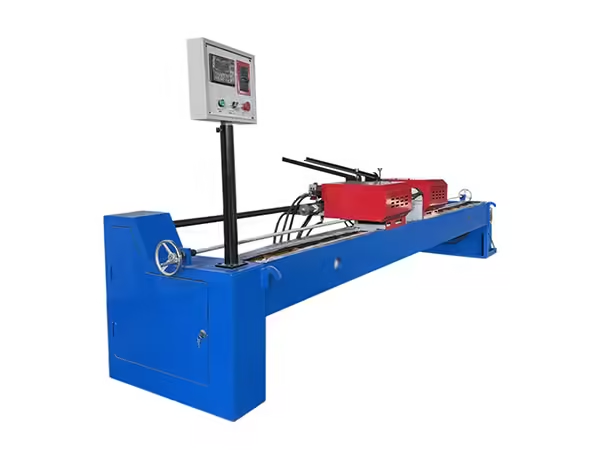
Cutting tools gradually change during production. Even when the machine structure and workpiece position remain stable, tool wear can alter cutting force, surface condition, chamfer geometry, or final dimensions.
An automatic production cycle can sometimes make this change less obvious because the machine continues operating normally while the cutting edge slowly deteriorates. Operators should therefore monitor product quality rather than waiting for the tool to fail completely.
Tool replacement should also be straightforward enough that routine maintenance does not require excessive realignment. After a new cutting tool is installed, the machine should return to the established processing condition through a defined adjustment or verification procedure.
This is particularly important for batch roller production because inconsistent tool setup can create a dimensional shift between production runs even when every other machine parameter remains unchanged.
Machine design should therefore provide practical tool access, clear adjustment methods, and enough working space for inspection. Maintainability is part of production consistency rather than a separate concern that only becomes important after the equipment has been used for several years.
Changeover Should Reflect the Real Roller Product Range
Roller manufacturers often produce several shaft lengths, diameters, or end configurations. An automatic blunt roller machine therefore needs enough flexibility to handle normal product variation without turning every changeover into a completely new setup.
The most useful way to evaluate flexibility is not to ask for the widest possible theoretical range. It is to identify the dimensions that are produced most frequently and determine how efficiently the machine can move between those specifications.
Length changes may involve repositioning stops or entering new parameters. Diameter changes can require fixture adjustments or different supporting components. Chamfer dimensions and center-hole requirements may also change depending on the shaft drawing.
A well-designed changeover process should make these adjustments repeatable. Operators should be able to return to an established product specification without relying entirely on trial machining and personal memory.
This is particularly valuable when multiple shifts or operators use the same equipment. Process knowledge should be reflected in machine settings, fixtures, drawings, and procedures rather than existing only as informal operator experience.
Automation Should Improve Process Control, Not Only Speed
The word “automatic” is often associated with production speed, but the more important advantage is usually process consistency. Automatic loading, clamping, machining, tool return, and unloading can reduce the number of manual decisions required during each cycle.
If an operator manually positions every shaft, small differences can occur from one component to the next. If the machine controls the positioning sequence, the same movement can be reproduced more consistently.
Automation can also coordinate both ends of the machine. Instead of processing one side and then waiting for another manual operation, double-end machining units can work within the same production cycle. This can reduce auxiliary handling time while preserving the relationship between both end features.
However, automatic movement cannot compensate for incorrect fixtures, worn cutting tools, unstable raw material, or poor machine alignment. The mechanical process needs to be stable before automation can reproduce it reliably.
For this reason, the quality of an automatic blunt roller machine should be evaluated through the combination of machine structure, fixtures, tooling, control logic, and production repeatability rather than by the number of automated functions listed in the specification.
Line Balance Matters More Than One Machine’s Maximum Speed
An automatic blunt roller machine normally operates between other production stages, so its cycle time should fit the capacity of the complete roller manufacturing line.
If end processing is much faster than the next shaft-milling operation, unfinished components may accumulate between machines. If end processing is slower than the upstream cutting operation, it may become the bottleneck that determines total shaft output.
Machine speed should therefore be considered together with loading, machining, unloading, product changeover, inspection, and workpiece transfer.
An illustrative production analysis might look like this:
| Process | Example Cycle | Main Production Variable |
| Shaft cutting | 22 sec | Length positioning |
| End facing/chamfering | 27 sec | Clamping and machining |
| Flat milling | 31 sec | Feature machining |
| Groove processing | 25 sec | Positioning |
| Assembly preparation | 24 sec | Component handling |
These values are only examples for explaining production balance and are not equipment performance claims.
In this example, reducing the blunt-end machining cycle from 27 to 20 seconds would not automatically increase total finished output because flat milling remains slower. The better production decision would be based on the entire process flow rather than the maximum speed of one machine.
Maintenance Helps Preserve Long-Term Accuracy
Automatic roller-processing equipment contains moving slides, fixtures, cutting tools, hydraulic or mechanical systems, sensors, bearings, and positioning components that operate repeatedly during batch production. These parts need routine inspection if the machine is expected to maintain the same processing condition over time.
Fixture surfaces deserve particular attention because they directly affect workpiece position. Gradual wear at a locating point can create dimensional drift even while the machine continues to complete its automatic cycle without alarms.
Tool holders and cutting edges should also be inspected for wear, looseness, or damage. Moving components need appropriate lubrication and adjustment so that repeated positioning remains stable.
Maintenance should be connected with production data. If operators notice that finished lengths or center-hole positions begin to require more adjustment than before, the cause should be investigated mechanically rather than immediately compensating through control parameters.
Repeated parameter correction can hide fixture wear or machine movement until the problem becomes larger. A stable maintenance program helps keep the original relationship between machine settings and actual workpiece dimensions.
What to Consider Before Selecting an Automatic Blunt Roller Machine
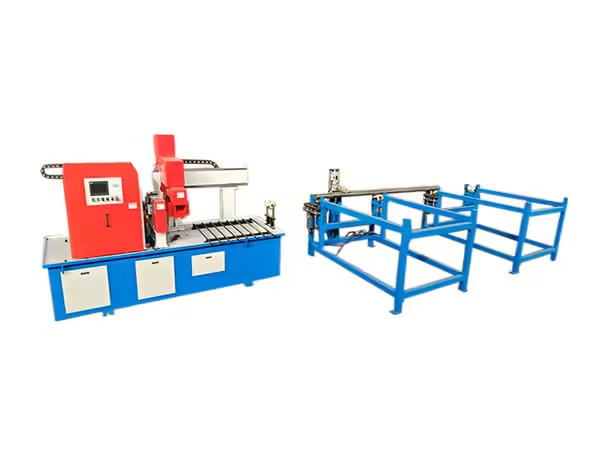
Equipment selection should begin with the workpiece drawing rather than with a generic machine model. Shaft diameter, total length, material, end geometry, chamfer requirements, center-hole specifications, normal batch size, and downstream processes all influence which machine configuration is suitable.
It is also important to define the normal product range separately from occasional extreme specifications. A machine designed around the most frequently produced roller shafts can usually provide a more practical production setup than one made unnecessarily complex to accommodate rare dimensions.
The required automation level should follow the same logic. High-volume repeated production can benefit from automatic loading and unloading, while lower-volume mixed production may place greater value on simple adjustment and flexible changeover.
Manufacturers should also evaluate how the machine will connect with adjacent processes. The finished shaft should leave the automatic blunt roller machine in a condition that can move directly into milling, grooving, turning, assembly, or inspection without unnecessary corrective work.
A machine is therefore best evaluated not only by what it can do independently, but by how well it supports the entire roller manufacturing process.
Conclusion
An automatic blunt roller machine performs an important preparation function in conveyor roller manufacturing by creating controlled end geometry before the shaft or roller component enters later machining and assembly stages. Flat-end machining can establish a more consistent finished length, chamfering prepares the edge, and center-hole processing can create a useful reference for subsequent shaft operations. When both ends are processed within one coordinated setup, the machine can also reduce the dimensional variation introduced by repeated workpiece repositioning.
The quality of this process depends on much more than the cutting unit itself. Material support, locating, clamping, centerline control, tooling condition, machine alignment, and workpiece geometry all influence the finished result. Automation improves production most effectively when these mechanical fundamentals are already stable, because automatic loading and machining can then reproduce the same process with less dependence on repeated manual adjustment.
Within a complete roller production line, end processing should also be coordinated with tube cutting, shaft milling, grooving, bearing assembly, welding, and inspection. The most valuable machine is not necessarily the one with the shortest isolated cycle time, but the one that provides a predictable workpiece to the next manufacturing stage while maintaining consistent results across repeated batches.
For this reason, selecting an automatic blunt roller machine should begin with the actual shaft drawing, production range, required end geometry, downstream processes, and expected output. When the machine, fixtures, tooling, and automation are matched to these conditions, end processing becomes a controlled foundation for more stable conveyor roller manufacturing.
FAQ
What is an automatic blunt roller machine used for?
In conveyor roller manufacturing, an automatic blunt roller machine is used for controlled roller or shaft end preparation, including operations such as end facing, chamfering, and center-hole machining. These processes establish dimensions and reference surfaces that support later shaft machining, assembly, and inspection.
Why is double-end processing useful for roller shafts?
Double-end processing allows both sides of a roller shaft to be machined within one coordinated setup. This reduces repeated workpiece reversal and re-clamping, helping maintain a more consistent relationship between opposite ends while also reducing auxiliary handling during batch production.
How does automation improve roller end processing?
Automation can control loading, positioning, clamping, machining cycles, tool return, and unloading in a repeatable sequence. Its main advantage is reducing manual variation between workpieces, although stable fixtures, suitable tooling, accurate machine alignment, and consistent raw materials are still essential.
What affects the accuracy of an automatic blunt roller machine?
Finished accuracy can be influenced by workpiece straightness, fixture positioning, clamping stability, cutting-tool condition, machine alignment, centerline control, material variation, and repeated positioning accuracy. Several consecutive parts should therefore be inspected when evaluating production consistency.
What information should be prepared before selecting the machine?
Useful information includes shaft diameter and length, material, finished end geometry, chamfer dimensions, center-hole requirements, normal production range, batch quantity, loading method, downstream machining processes, and required automation. Technical drawings provide the clearest basis for machine selection.
 English
  French
  Spanish