
Table of Contents
Introduction
Rollers are easy to underestimate because they are visually simple components. In practice, their geometry, bearing arrangement, shell material, shaft design, sealing, alignment, and installation position can directly influence how reliably a conveying system operates.
This becomes especially important when comparing rollers conveyors with belt conveyor systems. Although both use rotating cylindrical components to support or move material, the rollers do not necessarily perform the same job. In one system, the conveyed item may rest directly on the rollers. In another, the rollers support and guide a moving belt carrying bulk material.
A conveyor system can use different conveying principles depending on the product, load, route, operating environment, and degree of automation required. Understanding those principles first makes roller selection much more practical.
This guide focuses on several questions that matter when specifying rollers:
- How do roller-based and belt-based conveying systems differ?
- What does a roller actually need to do in each system?
- Which dimensions matter most?
- How do load and operating conditions influence roller construction?
- When should impact, return, self-aligning, or trough rollers be considered?
- Why are bearings and seals critical to long-term performance?
- How can roller selection reduce unnecessary conveyor maintenance?
- What information should be defined before choosing a roller configuration?
Rather than selecting rollers by diameter alone, a more reliable approach is to consider them as part of the complete conveying process.
Rollers Conveyors and Belt Conveyors Are Not the Same System
The phrase rollers conveyors is often associated with conveying systems that use multiple cylindrical rollers to support and move items. Depending on the design, movement can be created by gravity, external drive mechanisms, or powered rollers.
Belt conveyors work differently.
Instead of carrying the material directly on each roller, a continuous belt becomes the primary conveying surface. Idler rollers positioned beneath or around the belt support its shape and help it travel along the intended path.
That distinction changes what you should expect from the roller.
Direct-load rollers
In a roller conveyor, the conveyed object may contact several rollers simultaneously.
The roller therefore has to accommodate factors such as:
- Unit load
- Roller spacing
- Product bottom geometry
- Contact pressure
- Start-stop frequency
- Driven or non-driven operation
Boxes, containers, panels, or other stable unit loads may be suitable for this arrangement when their geometry allows reliable support.
Belt-supporting rollers
In a belt conveyor, idlers support the belt rather than carrying the conveyed material through direct item-to-roller contact.
Their roles can include:
- Supporting the carrying belt
- Forming a trough profile
- Supporting the return belt
- Absorbing loading impact
- Helping correct belt tracking
- Maintaining the required conveyor geometry
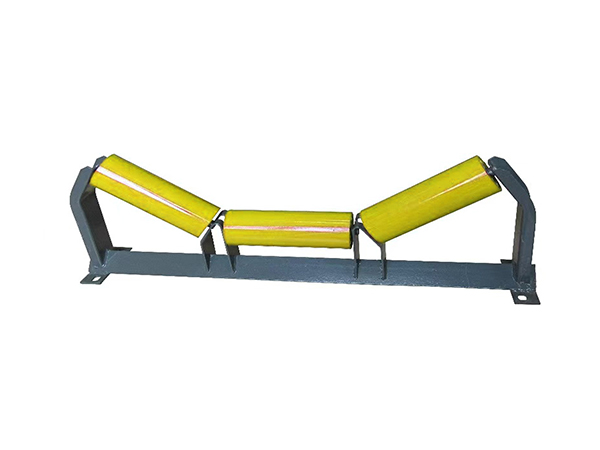
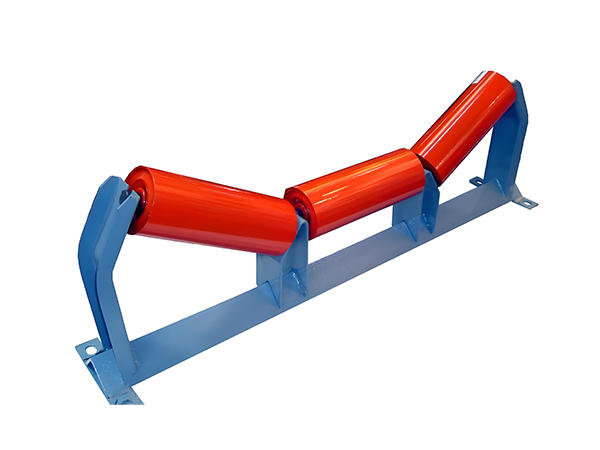
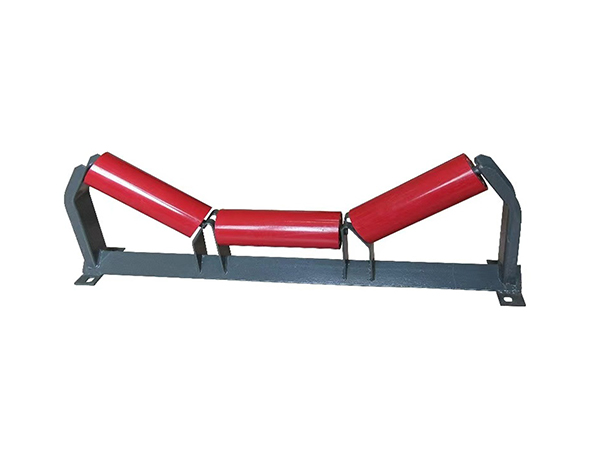
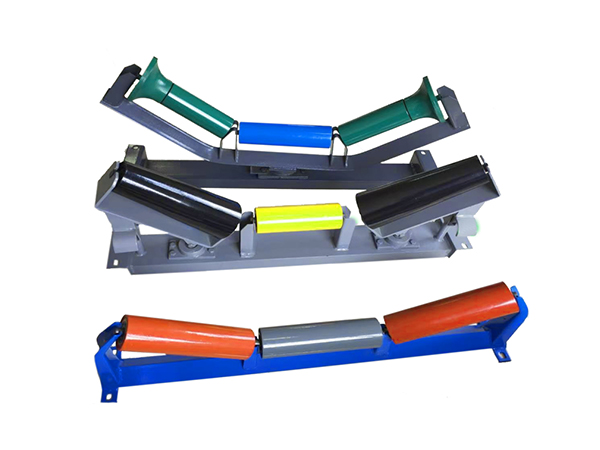
Terok’s current conveyor rollers range includes several idler configurations such as trough, flat, return, training, self-aligning, garland, and offset arrangements, illustrating how roller function changes according to installation position.
The practical lesson is that two rollers of similar external dimensions can serve very different engineering purposes.
Roller Function Should Be Defined Before Roller Size
A common selection mistake is starting with:
“What diameter roller do I need?”
Diameter matters, but it should come after defining the function.
A better sequence is:
Application → load → roller function → geometry → material → bearing → sealing → installation.
This prevents dimensions from being selected without enough operating context.
Carrying rollers
Carrying rollers support the working side of a conveyor belt. Depending on conveyor geometry, they may be installed flat or as part of a troughing set.
Their design should consider the load transmitted through the belt, spacing between idler sets, belt characteristics, shaft support, and operating environment.
Return rollers
After material is discharged, the belt travels back toward the loading area.
Return rollers support this unloaded belt path. Although the material load has been removed, return rollers still need stable rotation, suitable spacing, reliable bearings, and appropriate resistance to environmental contamination.
Impact rollers
The loading zone creates a different operating condition.
Material arriving on the conveyor can introduce impact forces that are not present along normal carrying sections. Impact rollers are designed to help manage these forces and reduce the direct shock transferred through the belt and supporting structure. Terok’s current product information similarly positions buffer or impact rollers for material-loading areas where impact protection is needed.
Self-aligning rollers
A belt that moves away from its intended path can create edge wear, uneven loading, spillage, and unnecessary contact with surrounding structures.
Self-aligning or training arrangements are intended to assist belt guidance where tracking control is required.
This illustrates why rollers conveyors should not be treated as a category in which every roller is interchangeable.
Roller Conveyor vs Belt Conveyor: Key Differences
Before selecting components, it helps to compare how the two systems behave.
| Selection Factor | Roller Conveyor | Belt Conveyor |
|---|---|---|
| Conveying surface | Individual rollers | Continuous belt |
| Typical roller role | Directly supports conveyed item | Supports or guides conveyor belt |
| Material contact | Product contacts rollers | Material generally contacts belt |
| Load distribution | Across several adjacent rollers | Through belt to idler arrangement |
| Small loose material | Depends heavily on item geometry | Generally better contained by belt |
| Roller spacing | Important for supporting products | Determined by belt and load requirements |
| Tracking concern | Product guidance | Belt tracking is a major consideration |
| Impact zones | Depends on item loading method | Specialized impact idlers may be required |
| Return path | No continuous belt return | Return-side belt support required |
| Typical roller groups | Straight roller arrangement | Carrying, trough, return, impact, training sets |
Neither design is universally superior.
The correct system depends on what is being transported and how it needs to move.
For SEO and purchasing research around rollers conveyors, this distinction is particularly useful because users searching for “conveyor rollers” may actually require very different products depending on whether they are designing a unit-handling conveyor or a belt-supported bulk conveying system.
Load Conditions Determine More Than Roller Capacity
Load is not simply a number attached to a specification sheet.
You also need to understand how that load reaches the roller.
A static, evenly distributed load behaves differently from a material stream dropping onto a conveyor. Likewise, a conveyor operating continuously creates different demands from equipment that runs intermittently.
Consider load distribution
In rollers conveyors carrying unit loads, ask:
- How many rollers normally support one item?
- Can the product bridge across several rollers?
- Is its underside flat?
- Does its center of gravity remain stable?
- Will concentrated points apply additional force?
A product should normally have sufficient support as it travels from one roller to the next.
Large gaps may allow smaller or irregular items to become unstable.
Consider dynamic loading
Dynamic forces can be more demanding than steady loads.
They may occur during:
- Material impact
- Conveyor starting
- Conveyor stopping
- Product accumulation
- Sudden loading
- Belt movement
- Misalignment
- Material buildup
For belt systems, the loading zone deserves particular attention because falling bulk material can create concentrated impact.
Selecting an ordinary carrying roller for a high-impact position simply because the dimensions fit may not provide the intended operating behavior.
Roller Diameter, Length, and Spacing Must Work Together
Dimensions are important, but no single dimension determines suitability.
Diameter, shell thickness, roller length, shaft construction, and spacing interact with each other.
Roller diameter
Roller diameter influences structural behavior and rotational characteristics.
However, selecting a larger diameter does not automatically make a roller better for every conveyor.
The appropriate size depends on factors such as:
- Belt or product dimensions
- Applied load
- Roller length
- Installation space
- Bearing arrangement
- Shaft design
- Required rotational behavior
Terok’s current conveyor roller product information shows multiple roller diameters and lengths rather than one universal specification, reflecting the need to configure rollers according to different conveyor requirements.
Roller length
The roller needs to support the intended conveying width while fitting correctly into the supporting structure.
For belt conveyors, length is related to belt width and idler configuration.
For rollers conveyors handling unit loads, roller length also needs to suit the dimensions and lateral stability of the product.
An excessively narrow support area can create unstable movement. Excessive width may unnecessarily increase component size and rotating mass.
Roller spacing
Spacing should be treated as a system parameter rather than a mounting convenience.
In unit handling, spacing determines how many rollers remain underneath the product.
In belt conveyors, idler spacing influences the support provided to the belt between adjacent sets.
If spacing increases, the load carried by individual support locations can also change.
Bearings and Seals Are Small Components with Large Consequences
Much of the visible roller is simply a cylindrical shell.
The less visible components often determine how consistently it rotates.
Bearings, bearing housings, seals, shaft interfaces, and assembly accuracy deserve serious attention when comparing conveyor rollers.
Bearings support more than rotation
A bearing needs to accommodate the operating load while maintaining appropriate rotational behavior.
Selection depends on more than roller diameter.
Engineers should consider:
- Radial load
- Operating speed
- Shaft geometry
- Installation accuracy
- Contamination exposure
- Temperature conditions
- Duty cycle
- Maintenance requirements
A larger bearing is not automatically the correct bearing.
What matters is whether the complete assembly matches the operating condition.
Sealing protects the bearing environment
Conveyors frequently operate where dust, fine particles, water, or other contaminants can approach rotating components.
The seal system helps separate these conditions from the bearing.
Seal effectiveness should therefore be considered together with:
- Installation environment
- Roller orientation
- Contaminant type
- Shaft interface
- Bearing arrangement
- Maintenance strategy
A strong shell combined with an unsuitable sealing arrangement can still create an unreliable roller.
Material Selection Should Match the Operating Environment
Roller material affects more than appearance.
Depending on the conveyor design, different materials can influence wear resistance, mass, corrosion behavior, surface interaction, noise, and suitability for particular operating environments.
Current Terok roller specifications include multiple pipe material options, demonstrating that material selection varies with application rather than following one fixed configuration.
Steel roller construction
Steel is commonly used where structural strength and industrial durability are important.
Its suitability still depends on:
- Wall thickness
- Surface treatment
- Operating environment
- Roller dimensions
- Shaft and bearing design
Material specification should therefore be evaluated as part of the complete roller assembly.
Polymer-based roller construction
Certain conveyor applications can use polymer-based materials where their particular physical characteristics are beneficial.
The decision should consider:
- Load
- Temperature
- Wear
- chemical exposure
- impact
- dimensional stability
- operating speed
Replacing one material with another without reassessing these conditions can change roller behavior.
Rubber-covered or impact configurations
Rubber elements can be used where cushioning or surface interaction is important.
For impact zones, the objective is not simply to make the roller softer. The complete arrangement should manage impact energy while continuing to support the belt correctly.
This is why material and roller function should always be specified together.
Alignment Has a Direct Effect on Conveyor Performance
A high-quality roller can still perform poorly when installed incorrectly.
Alignment is a system property.
The roller, bracket, frame, belt, drive components, and neighboring idlers all contribute to how smoothly the conveyor operates.
Shaft and bracket position matter
If roller mounting points are not positioned correctly, the roller axis may differ from the intended conveyor geometry.
This can introduce:
- Uneven contact
- Additional rotational resistance
- Belt tracking problems
- Localized wear
- Unstable product movement
For idler groups, several rollers must also work together geometrically.
A conveyor roller set may combine rollers and a supporting bracket into one functional arrangement, making the relationship between individual roller geometry and overall idler-set alignment especially important.
Manufacturing accuracy affects assembly accuracy
Roller alignment begins before installation.
Factors such as shaft machining, tube concentricity, bearing-seat location, welding, and assembly can influence finished roller geometry.
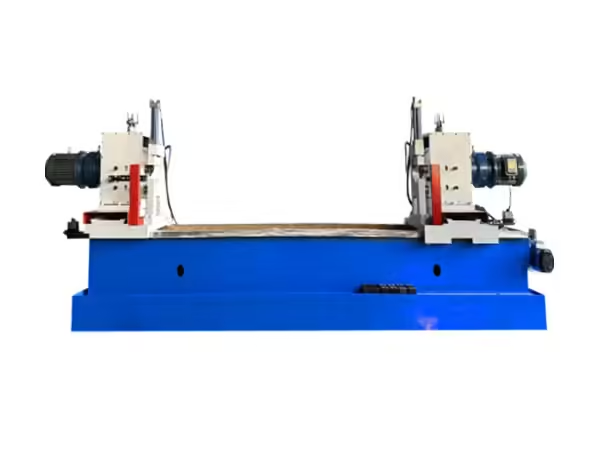
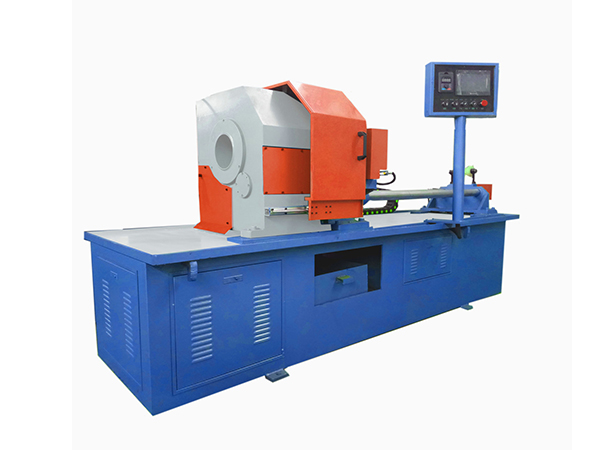
This is why roller production equipment and finished roller quality are closely connected.
A manufacturing process that controls these relationships consistently provides a stronger basis for reliable installation later.
How Roller Manufacturing Influences Conveyor Performance
When buyers evaluate rollers conveyors, attention often goes directly to the finished roller.
It is also useful to consider how the roller was manufactured.
A typical roller can require several controlled operations, such as:
Tube preparation → cutting → end processing → shaft machining → bearing-seat preparation → assembly → welding or closing operations → inspection.
Variation introduced during any stage can affect the finished component.
Tube cutting establishes an early reference
If tube length varies significantly, later assembly operations may require additional adjustment.
End quality can also influence subsequent locating or joining processes.
Shaft processing controls important interfaces
Roller shafts may include flats, grooves, threads, or other application-specific features.
Their dimensions and locations influence how the roller mounts into the conveyor structure.
Repeatability matters particularly when large numbers of interchangeable rollers are required.
Bearing assembly affects rotational behavior
Bearings need to be installed in the intended position without introducing unwanted alignment problems.
The relationship among shell, bearing housing, bearing, seal, and shaft determines how the assembly rotates as a whole.
Inspection should evaluate function
Checking only one external dimension is not enough.
Depending on the roller design, useful inspection may consider:
- Length
- Diameter
- Shaft geometry
- Runout
- Bearing fit
- Rotational resistance
- Seal assembly
- Weld quality
- Surface condition
The objective is a roller that functions consistently once it enters the conveyor, not simply one that looks correct after assembly.
How to Select Rollers Conveyors for a Real Application
A practical specification begins with operating information rather than with a product code.
Before selecting rollers, prepare the following details.
1. Define what is being conveyed
Identify whether the system handles:
- Individual units
- Bulk material
- Irregular material
- Fragile products
- High-impact material
This immediately narrows the appropriate conveyor and roller arrangement.
2. Define the load
Record normal operating load rather than only the maximum theoretical value.
Also identify whether loading is:
- Uniform
- Concentrated
- Impact-based
- Continuously changing
3. Define conveyor geometry
Useful information includes:
- Conveyor width
- Conveyor length
- Inclination
- Belt width
- Roller spacing
- Trough geometry
- Loading points
- Return arrangement
4. Define the operating environment
Consider dust, moisture, contamination, temperature variation, material buildup, outdoor exposure, and other application-specific conditions.
This information influences material, bearing, sealing, and maintenance decisions.
5. Define the duty cycle
A continuously operating conveyor creates different requirements from a system that runs only occasionally.
Operating hours, starts and stops, speed, and production patterns should be considered.
6. Define maintenance priorities
Think beyond installation.
Ask how rollers will be inspected, removed, replaced, cleaned, and accessed.
The most appropriate roller configuration should support both operation and practical maintenance.
Common Roller Selection Mistakes
Several mistakes can shorten component life or create unnecessary conveyor problems.
Selecting by diameter alone
Two rollers with the same diameter may have different shafts, bearings, seals, materials, shell thicknesses, and intended functions.
Diameter is only one specification.
Ignoring the installation position
A carrying roller, impact roller, return roller, and self-aligning roller solve different problems.
Using the same configuration throughout the conveyor can overlook the operating conditions of individual zones.
Focusing only on maximum load
Normal load distribution, impact, rotation, alignment, and environment all influence performance.
The highest load figure alone does not describe the complete application.
Treating every roller as an isolated component
Rollers interact with:
- Conveyor frames
- Brackets
- Belts
- Neighboring idlers
- Drive components
- Material flow
A component that appears suitable by itself may behave differently once installed.
Ignoring maintenance access
Rollers eventually require inspection or replacement.
Mounting arrangements should allow technicians to perform routine work without unnecessarily dismantling surrounding structures.
A Practical Roller Selection Framework
The following framework can help organize technical discussions before a final configuration is selected.
| Evaluation Area | Main Question | Why It Matters |
|---|---|---|
| Conveyor type | Is the load carried directly by rollers or by a belt? | Defines basic roller function |
| Material/load | What is being transported? | Determines loading behavior |
| Roller position | Carrying, return, impact, or training? | Defines application requirements |
| Dimensions | What width, diameter, and length are needed? | Ensures physical compatibility |
| Load distribution | How does force reach each roller? | Influences construction |
| Bearings | What load and duty must they support? | Affects rotation and durability |
| Seals | What contamination is present? | Protects internal components |
| Material | What environmental conditions exist? | Influences wear and compatibility |
| Alignment | How will rollers be mounted? | Affects tracking and movement |
| Maintenance | How will rollers be inspected and replaced? | Supports long-term operation |
This approach is more reliable than beginning with one component specification and working backward.
It also makes communication with a roller manufacturer more efficient because the supplier receives information about the actual application.
Conclusion
Rollers conveyors and belt conveyors may share similar cylindrical components, but their roller requirements can differ considerably.
In a roller conveyor, the transported item may rest directly on the rollers. Load distribution, spacing, product geometry, and drive method therefore become central selection factors.
In a belt conveyor, idlers primarily support and guide the belt. Their function may change across carrying, troughing, impact, return, and self-aligning positions.
For both systems, good roller selection goes far beyond diameter.
You should consider the complete relationship among load, roller function, length, shaft design, bearings, seals, material, alignment, spacing, manufacturing accuracy, and operating environment.
The most useful selection question is therefore not:
“Which roller is strongest?”
It is:
“Which roller configuration best controls the loads and operating conditions at this exact position in my conveyor?”
Once the question is framed this way, rollers become easier to specify and the entire conveying system becomes easier to engineer, maintain, and optimize.
FAQ
What are rollers conveyors used for?
Rollers conveyors use rotating cylindrical components to support or move materials through a conveying process. Depending on the design, products may contact the rollers directly, while belt conveyor idlers support and guide a continuous belt carrying the material.
How do I choose the correct conveyor roller?
Start with conveyor type, material being handled, load, roller position, working width, spacing, operating environment, and duty cycle. Then evaluate roller diameter, shell and shaft construction, bearings, seals, material, mounting geometry, and maintenance requirements.
What is the difference between carrying and return rollers?
Carrying rollers support the loaded side of a conveyor belt and may form part of a flat or troughing arrangement. Return rollers support the belt after material has been discharged. Their load conditions and installation positions differ, so they should not automatically use identical configurations.
When should impact rollers be used?
Impact rollers are generally used near material-loading zones where falling material creates higher dynamic forces. Their purpose is to help absorb loading impact and reduce the shock transferred to the belt and conveyor structure while maintaining suitable support through the loading area.
Why is roller alignment important in rollers conveyors?
Correct alignment helps rollers rotate in the intended direction and supports stable belt or product movement. Misalignment can contribute to uneven contact, tracking problems, additional resistance, localized wear, and unnecessary stress on rollers, bearings, belts, and supporting structures.
 English
  French
  Spanish