
Table of Contents
Introduction
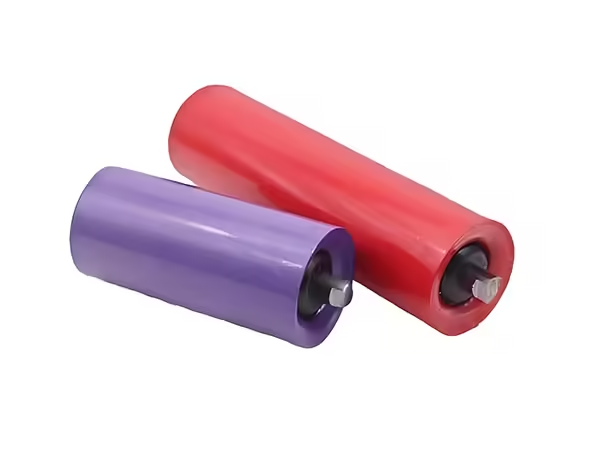
A conveyor roll looks simple: a cylindrical shell, a shaft, bearings, seals, and several connecting parts. In a working conveyor, however, that relatively simple component repeatedly supports load, rotates for long periods, interacts with the belt or conveyed material, and operates under conditions that may include dust, impact, moisture, vibration, and changing loads.
This is why conveyor roll selection should not begin with diameter alone.
A suitable roller must match the conveyor structure, operating load, belt width, speed, material characteristics, installation position, and surrounding environment. The bearing and sealing arrangement must also work as a system with the shell and shaft.
For engineers, equipment operators, distributors, and companies specifying replacement components, several points deserve particular attention:
- Identify the exact function of the conveyor roll before choosing dimensions.
- Match roller type with carrying, return, impact, or tracking positions.
- Evaluate load distribution rather than maximum load alone.
- Consider shell, shaft, bearing, and seal design together.
- Check roller runout and assembly consistency where smooth belt movement matters.
- Match roller materials to the operating environment.
- Treat installation alignment as part of roller performance.
- Consider manufacturing consistency when ordering large quantities.
- Plan inspection and replacement around actual operating conditions.
Understanding these relationships helps you specify a conveyor roll according to how it will actually work rather than simply matching an old part number.
What Is a Conveyor Roll?
A conveyor roll is a rotating cylindrical component used to support a belt, conveyed product, or another moving element within a conveyor.
Within a general conveyor system, rollers may have very different functions depending on the system design. Some directly support products, while others form idler sets beneath conveyor belts.
This difference is important.
A roller used underneath the loaded side of a belt does not experience exactly the same operating condition as a return roller. Likewise, a roller installed underneath a loading point may experience significantly more impact than one positioned farther along the conveyor.
A complete conveyor roll generally contains several functional elements:
| Component | Primary Function | Why It Matters |
|---|---|---|
| Roller shell | Provides rotating support surface | Carries load and resists deformation |
| Shaft | Connects roller to supporting structure | Transfers load to mounting points |
| Bearing | Enables controlled rotation | Influences resistance and operating stability |
| Bearing housing | Holds bearing position | Maintains internal alignment |
| Seal system | Limits contaminant entry | Protects bearings and internal components |
| End components | Complete assembly and positioning | Affect installation and sealing |
| Surface treatment | Protects or modifies shell surface | Helps match environmental conditions |
Rather than evaluating these components independently, it is better to consider how they work together during actual conveyor operation.
Start Conveyor Roll Selection With Its Position
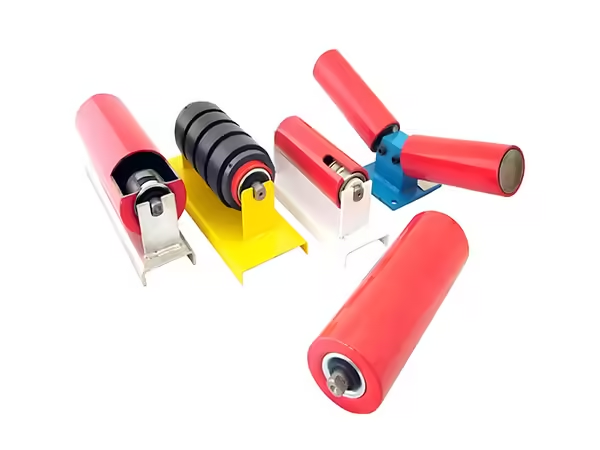
The first question is not “Which conveyor roll is strongest?”
It is “Where will this roller operate?”
The installation position determines much of the roller’s required behavior.
Carrying Rollers
Carrying rollers support the loaded side of a conveyor belt.
They may be positioned horizontally or combined into troughing arrangements that shape the belt around the transported material. These rollers need to support the belt and material load while maintaining stable rotation.
When selecting carrying rollers, consider:
- Belt width
- Material load
- Idler spacing
- Trough configuration
- Conveyor speed
- Shaft support
- Shell construction
- Bearing arrangement
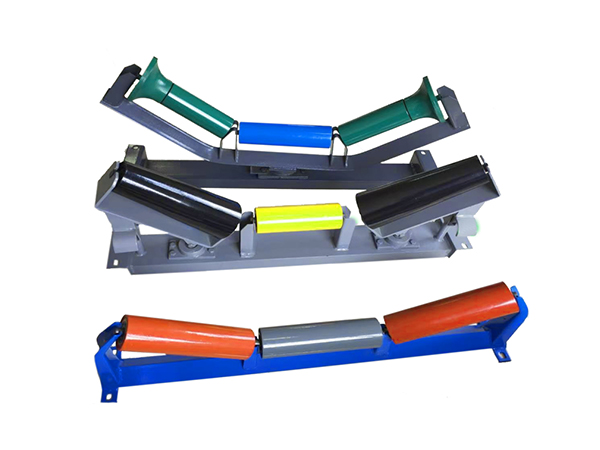
The site’s current conveyor rollers range includes different carrying, troughing, return, impact, training, and related idler configurations, reflecting the fact that conveyor roll design changes according to its function within the system.
Return Rollers
The belt must return after material has been discharged.
Return rollers support this section of belt.
Because the transported bulk material is no longer on the belt, the direct loading condition changes, but return rollers still face factors such as belt contact, contamination, alignment, rotational resistance, and long operating periods.
In some applications, material sticking to the belt can also influence the condition of return-side components.
Impact Rollers
Loading zones deserve special attention.
When material falls onto a belt, the conveyor experiences dynamic forces rather than only steady load. A conveyor roll designed for an impact position therefore needs to be evaluated differently from a standard carrying roller.
The objective is to help support the belt while managing the higher forces created where material enters the system.
Training and Self-Aligning Rollers
Conveyor belts do not always remain perfectly centered.
Structural alignment, uneven loading, contamination, component installation, and several other factors can influence belt tracking.
Training or self-aligning roller arrangements are designed to help manage this movement.
They should not, however, be treated as a substitute for correcting fundamental installation or alignment problems elsewhere in the conveyor.
Conveyor Roll Diameter and Length Must Match the Application
Diameter is one of the most visible roller specifications, but it is only useful when considered alongside load, length, wall thickness, shaft design, and operating speed.
Roller Diameter
A conveyor roll diameter affects structural behavior and rotational characteristics.
The appropriate diameter may depend on:
- Conveyor duty
- Belt dimensions
- Roller length
- Applied load
- Required shaft size
- Bearing arrangement
- Installation space
- Operating speed
Selecting the largest available diameter without considering these relationships can produce an unnecessarily mismatched component.
The better objective is to select a diameter appropriate for the complete roller design.
Roller Length
Roller length is generally related to the belt width and idler arrangement.
The roller should provide the required support while fitting correctly into the conveyor frame.
For troughing idlers, several rollers may work together rather than one full-width roller. Their dimensions and positions jointly determine the belt-supporting geometry.
Shell Wall Thickness
Shell thickness influences structural strength and resistance to deformation.
However, increasing thickness alone does not solve every roller problem.
A conveyor roll must also have an appropriate shaft, bearings, housings, and assembly structure. If another component becomes the limiting factor, increasing shell thickness may provide little practical improvement.
This is why roller specifications should be considered as one engineered assembly.
Load Should Be Evaluated as a Working Condition
The word “load” can be misleading if it is reduced to one number.
Conveyor rolls may experience steady loads, changing loads, concentrated forces, impact, belt tension effects, and additional forces caused by misalignment.
Static and Dynamic Loads Are Different
A steadily supported material load produces a different mechanical condition from material falling onto a loading zone.
Dynamic loading may occur during:
- Material loading
- Conveyor startup
- Conveyor stopping
- Irregular material flow
- Belt movement
- Blockages
- Sudden load changes
The roller position therefore needs to be considered when determining the appropriate construction.
Roller Spacing Changes Load Distribution
Idler spacing affects how the belt and material load are distributed among support points.
Two conveyors carrying similar material can therefore place different demands on individual rollers if their structural layouts differ.
A practical conveyor roll specification should consider:
Load + spacing + belt geometry + roller arrangement.
None of these variables should be evaluated completely independently.
Troughing Geometry Also Changes Load Distribution
In troughing arrangements, the center and side rollers do not necessarily experience the load in exactly the same manner.
The belt profile, material distribution, and idler geometry influence how forces move through the roller set into the supporting frame.
This makes roller-set design an important part of the overall selection process.
Bearings and Seals Often Determine Long-Term Conveyor Roll Behavior
The shell receives much of the visual attention, but bearings and seals can have a major effect on how a conveyor roll performs over time.
A roller needs to rotate under load without creating unnecessary resistance while its internal components remain protected from the surrounding environment.
Bearing Selection
Bearing requirements depend on several operating variables:
- Radial load
- Roller dimensions
- Shaft arrangement
- Rotational speed
- Operating duration
- Installation accuracy
- Environmental contamination
- Temperature
A bearing should therefore be selected according to the complete operating condition rather than simply by physical size.
Bearing Housing Accuracy
Bearing housing position affects the relationship between bearings, shaft, and roller shell.
If housings are installed inconsistently, internal alignment can change.
That variation may affect:
- Rotation
- Runout
- Bearing loading
- Vibration
- Long-term wear
In large-volume production, repeatable bearing-housing assembly is therefore an important manufacturing consideration.
Sealing Systems
Dust and fine particles are common around many material-handling systems.
The sealing arrangement helps protect internal roller components from this surrounding environment.
When evaluating a conveyor roll, the sealing system should be considered according to:
- Contamination type
- Moisture exposure
- Shaft interface
- Roller orientation
- Maintenance conditions
- Operating environment
An appropriate seal is not simply an additional component; it is part of the roller’s bearing protection strategy.
Roller Material Should Match the Conveyor Environment
No single material is ideal for every conveyor.
The appropriate construction depends on mechanical requirements and environmental conditions.
Steel Conveyor Roll
Steel roller shells are widely applicable where mechanical strength, rigidity, and industrial durability are required.
Their performance depends not only on the base material but also on:
- Shell thickness
- Manufacturing quality
- Surface condition
- Shaft design
- Bearing fit
- Operating environment
When surface protection is required, the treatment should be matched to actual exposure conditions.
Polymer-Based Rollers
Some conveyor applications use polymer-based roller constructions.
Depending on their design and material formulation, they may offer different characteristics in terms of mass, corrosion behavior, surface interaction, or operating noise.
However, material changes should be evaluated carefully against:
- Applied load
- Wear
- Temperature
- Chemical environment
- Operating speed
- Impact
- Dimensional requirements
Replacing steel with another material without considering these variables may change the roller’s mechanical behavior.
Rubber and Impact Surfaces
Rubber rings or related resilient elements may be used in impact or specialized roller configurations.
Their purpose should be defined by the application.
For loading zones, the roller should help support the belt while managing the shock generated as material enters the system.
The complete idler arrangement remains important; surface material alone cannot compensate for unsuitable conveyor geometry.
Manufacturing Accuracy Affects Conveyor Roll Performance
Two conveyor rolls can share the same nominal dimensions yet behave differently when installed.
One reason is manufacturing consistency.
Important production variables can include:
- Tube cutting
- Shell concentricity
- Bearing housing location
- Shaft machining
- Groove position
- End geometry
- Bearing installation
- Welding
- Assembly
- Runout
This is particularly important when a conveyor uses large numbers of rollers.
A small dimensional variation that seems insignificant on one unit can create inconsistent behavior when repeated across an entire system.
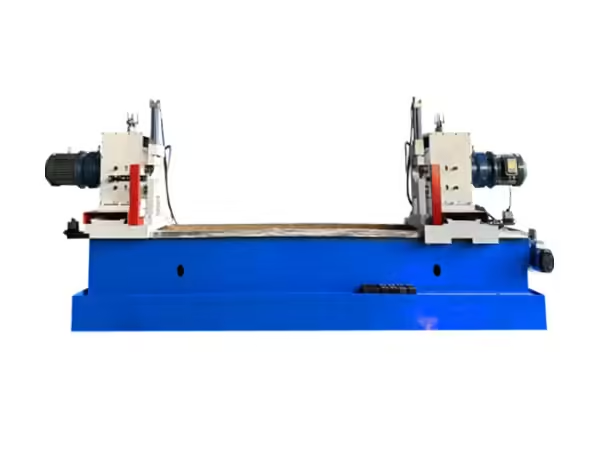
Tube Preparation
The roller shell begins with tube preparation.
Consistent cutting creates a predictable starting geometry for subsequent operations.
Poor length consistency may complicate:
- Bearing housing positioning
- Assembly
- Welding
- Overall roller dimensions
It is therefore more efficient to control variation early in the manufacturing process.
Shaft Processing
The shaft connects the conveyor roll to the surrounding structure.
Depending on the design, shaft features may include:
- Flats
- Grooves
- Threads
- Slots
- Stepped sections
- Mounting features
Feature location needs to remain consistent so replacement rollers can fit into the intended conveyor structure.
Bearing-Seat Assembly
Bearing-related components should remain aligned relative to the shell and shaft.
Assembly methods that repeatedly establish the same position can help create more consistent finished rollers.
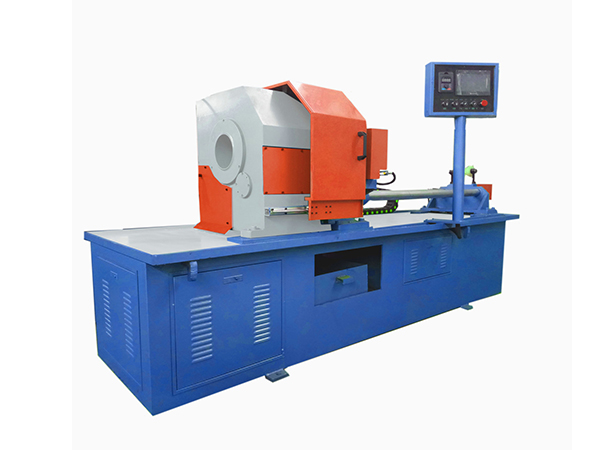
Welding
Where welding is part of the roller construction, it should provide the intended joint without introducing excessive distortion.
This requires attention to:
- Workpiece positioning
- Fixture stability
- Welding sequence
- Heat input
- Assembly geometry
The manufacturing operation is therefore closely connected to final conveyor roll quality.
Runout and Rotational Resistance Deserve More Attention
A roller can have the correct diameter and length while still rotating poorly.
Two practical performance characteristics are runout and rotational resistance.
What Is Runout?
Runout describes how much a rotating surface deviates from its intended rotational path.
Excessive runout can result from factors such as:
- Shell variation
- Bearing-seat misalignment
- Shaft geometry
- Welding distortion
- Assembly inconsistency
In a conveyor, excessive variation may contribute to vibration or less stable belt support.
Rotational Resistance
A conveyor roll should rotate predictably under its intended operating load.
Unnecessary resistance can be influenced by:
- Bearing condition
- Seal contact
- Internal alignment
- Assembly
- Contamination
- Shaft geometry
Very low resistance should not be pursued by compromising sealing or structural requirements. The objective is appropriate rotational behavior for the actual operating environment.
Why Repeated Testing Matters
One good roller does not prove consistent production.
For larger projects, evaluating multiple samples can provide better information about manufacturing repeatability.
Useful checks may include:
| Inspection Item | What It Helps Evaluate |
|---|---|
| Overall dimensions | Installation compatibility |
| Shaft dimensions | Mounting consistency |
| Runout | Rotational geometry |
| Free rotation | Assembly behavior |
| Bearing fit | Internal positioning |
| Seal assembly | Protection consistency |
| Weld appearance/integrity | Joint quality |
| Surface condition | Manufacturing and handling quality |
The exact inspection plan should reflect the application rather than applying unnecessary controls to every dimension.
Conveyor Roll Sets Need System-Level Evaluation
Many belt conveyors do not use individual rollers independently.
Several rollers can be assembled into an idler set supported by a common bracket.
A conveyor roller set therefore needs to be considered as a geometric system in which rollers, brackets, mounting positions, and belt profile interact.
Troughing Sets
A troughing set typically uses angled rollers to shape the belt into a carrying profile.
The configuration should suit factors such as:
- Belt width
- Material behavior
- Conveyor structure
- Load distribution
- Required trough geometry
Changing one component can alter the relationship between the belt and the complete set.
Flat Roller Sets
Flat arrangements may be suitable where the belt needs horizontal support.
The choice between flat and troughing designs should follow the conveying requirement rather than treating either as universally preferable.
Impact Sets
Loading zones can combine specialized rollers with an appropriate supporting structure.
The complete arrangement must manage loading forces rather than expecting one component to solve the entire impact problem.
Training Sets
Training arrangements are used where belt guidance requires additional control.
They should work together with correct conveyor-frame alignment, roller installation, loading distribution, and belt condition.
Alignment Can Make a Good Conveyor Roll Perform Poorly
Component quality cannot fully compensate for incorrect installation.
A conveyor roll needs to be positioned correctly relative to neighboring rollers, the belt, brackets, and conveyor frame.
Misalignment can contribute to:
- Belt tracking problems
- Uneven roller loading
- Additional resistance
- Localized wear
- Belt edge contact
- Vibration
- Premature component wear
Check the Supporting Frame
Replacing a roller without checking the surrounding frame can leave the underlying problem unchanged.
When abnormal roller wear appears repeatedly in the same location, inspect:
- Bracket condition
- Mounting surfaces
- Frame alignment
- Belt tracking
- Material buildup
- Neighboring rollers
Repeated component failure can sometimes indicate a system issue rather than a roller defect.
Installation Accuracy Matters Across an Idler Set
Rollers within the same set should work together.
If mounting points differ substantially, the belt may not contact the rollers in the intended manner.
This can change how load is distributed across the set.
For this reason, installation quality should be treated as part of conveyor roll performance.
How to Specify a Conveyor Roll Before Ordering
A complete technical request usually produces better results than simply providing a roller diameter and length.
Before selecting a roller, prepare as much of the following information as possible:
| Specification Area | Information to Provide |
|---|---|
| Conveyor type | Belt conveyor or roller conveyor |
| Roller function | Carrying, return, impact, training, other |
| Belt width | Required conveyor belt dimension |
| Roller dimensions | Diameter and working length |
| Shaft | Diameter, length, and end configuration |
| Material | Shell and relevant component material |
| Load | Normal operating conditions |
| Speed | Conveyor operating speed |
| Environment | Dust, moisture, temperature, contamination |
| Installation | Bracket and mounting arrangement |
| Special requirements | Impact, tracking, surface, sealing, etc. |
This information allows the conveyor roll to be evaluated as an operating component rather than an isolated cylinder.
Provide Drawings Where Possible
A technical drawing can communicate dimensional relationships more clearly than a written description alone.
Important drawing information may include:
- Overall length
- Tube length
- Shaft dimensions
- Shaft-end details
- Groove positions
- Mounting dimensions
- Roller diameter
For replacement projects, the condition of the surrounding conveyor should also be checked before assuming that the existing roller design is automatically the best reference.
Common Conveyor Roll Selection Mistakes
Several recurring mistakes can make conveyor maintenance more difficult.
Choosing Only by External Dimensions
Matching diameter and length does not guarantee equivalent performance.
Bearings, shaft geometry, seals, shell construction, and intended application also matter.
Using the Same Roller Everywhere
A conveyor can contain carrying, return, impact, and tracking positions.
Their operating conditions differ.
A single universal configuration may therefore be unsuitable across the entire conveyor.
Ignoring the Environment
A roller operating in relatively clean conditions does not face the same sealing challenge as one exposed to continuous dust or moisture.
Environmental information should be part of the specification.
Ignoring Manufacturing Repeatability
One acceptable sample is useful, but larger quantities require consistency.
For repeat orders, dimensional and functional repeatability becomes increasingly important.
Treating Roller Failure as an Isolated Event
When multiple rollers fail in the same conveyor area, examine the system.
Misalignment, excessive material buildup, abnormal impact, incorrect mounting, or other operating factors may contribute to recurring problems.
A Practical Conveyor Roll Selection Framework
A useful final check is to work through the following sequence:
Application
→ Roller position
→ Load
→ Conveyor geometry
→ Diameter and length
→ Shaft design
→ Bearing arrangement
→ Sealing
→ Material
→ Manufacturing consistency
→ Installation
→ Maintenance
This sequence avoids putting component dimensions ahead of application requirements.
It also makes comparisons more meaningful.
Instead of asking whether one roller specification looks stronger than another, you can evaluate whether each design matches the same operating conditions.
That is particularly important for industrial conveyor projects where component reliability depends on interactions between many parts of the system.
Conclusion
A conveyor roll should not be selected as a simple cylindrical replacement part.
It functions as part of a mechanical system in which load, belt geometry, supporting structure, bearings, seals, shaft design, alignment, operating environment, and manufacturing accuracy all interact.
The first step is to identify where the roller operates.
Carrying rollers support the loaded belt. Return rollers support the returning belt. Impact rollers address loading-zone conditions. Training arrangements assist with belt guidance. Each role creates different requirements.
Dimensions come next, but diameter and length alone are insufficient.
Bearing design influences rotation. Sealing helps protect internal components. Shell and shaft construction must support the required loading conditions. Manufacturing processes affect runout and assembly consistency. Installation determines whether a correctly produced conveyor roll can perform as intended.
For practical specification work, the best question is not simply:
“What conveyor roll size fits my conveyor?”
A more useful question is:
“What roller configuration best matches the load, position, environment, belt geometry, and operating conditions at this location?”
That approach produces a much stronger technical basis for selecting, replacing, and maintaining conveyor rollers.
FAQ
What is a conveyor roll used for?
A conveyor roll provides rotating support within a conveying system. Depending on its position, it may support a loaded belt, return belt, impact zone, or tracking arrangement. Its design should match the load, conveyor geometry, environment, bearing requirements, and installation method.
How do I choose the correct conveyor roll size?
Start with belt width, installation position, load, idler arrangement, and available mounting dimensions. Then determine suitable roller diameter, length, shaft geometry, and shell construction. Roller size should be evaluated together with bearings, seals, speed, and operating conditions.
What is the difference between a carrying and return conveyor roll?
A carrying conveyor roll supports the loaded side of the belt, while a return roller supports the belt after material has been discharged. Because their positions and loading conditions differ, their spacing, surface configuration, dimensions, and construction may also require different specifications.
Why are bearings important in a conveyor roll?
Bearings allow the shell to rotate around the shaft while supporting operating loads. Their performance is influenced by load, speed, alignment, sealing, contamination, and assembly accuracy. A suitable bearing system helps maintain stable rotation throughout normal conveyor operation.
What causes premature conveyor roll failure?
Premature problems may be associated with contamination, bearing damage, poor sealing, misalignment, abnormal impact, incorrect loading, installation errors, material buildup, or unsuitable roller specifications. Repeated failures in one area should prompt inspection of the surrounding conveyor system.
 English
  French
  Spanish