
If you are involved in metal fabrication or pipe processing, you already know how critical cutting precision is for downstream production. A small deviation in pipe length, angle, or edge quality can affect welding quality, assembly accuracy, and overall structural performance.
This is where a laser pipe cutting machine changes the game. Unlike traditional mechanical cutting systems, laser technology allows you to achieve high-speed, high-precision, and burr-free pipe cutting with minimal manual intervention. More importantly, it helps you stabilize production quality while reducing labor intensity and material waste.
In this article, you will learn how this equipment works, what makes it different from conventional cutting systems, how you can apply it in real production environments, and what benefits you can expect when upgrading your workshop.
Table of Contents
Why Laser Pipe Cutting Machines Are Becoming the Industry Standard
In modern pipe fabrication, demand for precision is increasing rapidly. Whether you are producing conveyor structures, machine frames, or industrial piping systems, consistency is now more important than ever.
Traditional cutting methods often rely on manual feeding or semi-automatic control. This introduces:
- Length deviation due to human error
- Rough cutting edges requiring secondary finishing
- Slow production cycles
- High operator dependency
- Inconsistent batch quality
Laser pipe cutting technology solves these issues by using a controlled beam combined with automated feeding systems. The result is a highly stable cutting process that reduces variation across thousands of repeated operations.
Industry production studies show that automated laser cutting systems can improve dimensional consistency by more than 30–50% compared to conventional mechanical cutting in repetitive production environments.
How a Laser Pipe Cutting Machine Works in Real Production
To understand the value of this machine, you need to look at its operational structure.
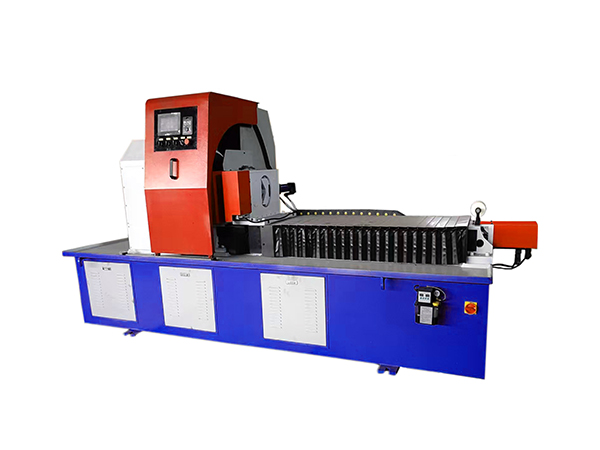
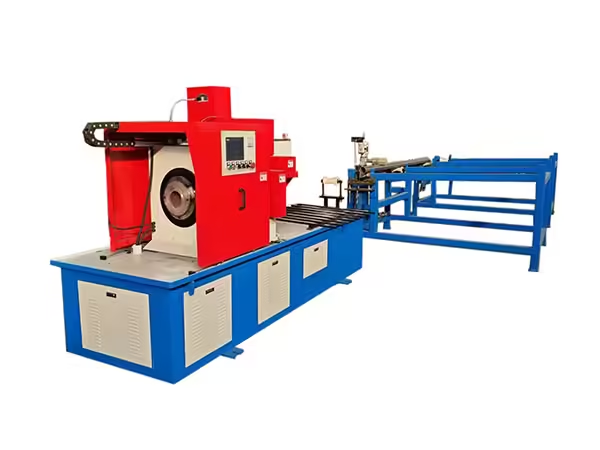
A laser pipe cutting machine typically integrates:
- PLC human-machine interface (HMI)
- Servo motor-driven feeding system
- Ball screw transmission system
- Linear guide rail structure
- High-speed rotating cutting head
The process is fully automated:
- You input the required cutting length through the interface
- The system automatically feeds the material
- Servo-driven motion ensures precise positioning
- The laser head performs cutting without rotating the pipe
- Finished pieces are discharged automatically or semi-automatically
One of the most important advantages is that the pipe itself does not need to rotate during cutting. Instead, only the cutting head operates. This reduces mechanical vibration and improves surface quality.
Core Advantages You Can Experience in Daily Operation
When you switch to a laser pipe cutting machine, the improvements are not theoretical—they are visible in daily production.
1. High Precision Cutting
The combination of servo motors and ball screw systems ensures extremely accurate feeding. This means every cut length remains consistent even in long production runs.
2. Smooth Cutting Surface
Because the laser performs non-contact cutting, the result is a clean edge with minimal burr formation. In many cases, secondary polishing is reduced or completely eliminated.
3. Unlimited Length Processing
The system supports continuous feeding, meaning you can process long pipes without interruption. This is especially valuable in industrial-scale production.
4. Reduced Labor Intensity
Instead of manual measurement and feeding, the system automates the entire workflow. Operators only need to input parameters and monitor operation.
5. Tool Consumption Reduction
Unlike mechanical blades, laser systems reduce physical tool wear, lowering long-term maintenance costs.
Real Production Case: Pipe Fabrication Workshop Upgrade
To understand the real-world impact, consider a typical pipe processing workshop scenario.
Before upgrading, the workshop used semi-automatic mechanical cutting systems. The main issues were:
- Frequent re-measurement required
- Inconsistent cutting length
- High rejection rate due to burrs
- Operator fatigue affecting accuracy
- Limited production speed
After introducing a laser pipe cutting machine, the workflow changed significantly:
- Cutting consistency improved noticeably across batches
- Burr formation reduced dramatically
- Production speed increased due to continuous feeding
- Operator workload decreased
- Rework rate dropped significantly
One of the most noticeable improvements was standardization. Instead of relying on operator skill, the system ensured every pipe followed the same programmed parameters.
Key Components That Determine Machine Performance
Not all laser pipe cutting systems perform the same. You should evaluate key structural components before making a decision.
- PLC control system for operation logic
- Servo motor system for precise feeding
- Ball screw and linear guide for motion stability
- Laser head for cutting precision
- Clamping system for material stability
- Cooling and safety systems for long-term operation
Each component plays a role in ensuring stable and repeatable cutting quality.
Technical Comparison of Cutting Systems
To help you understand where laser pipe cutting stands, here is a practical comparison:
| Feature | Traditional Mechanical Cutting | Laser Pipe Cutting Machine |
|---|---|---|
| Cutting Precision | Medium | High |
| Surface Quality | Requires finishing | Clean and smooth |
| Automation Level | Low to medium | High |
| Labor Requirement | High | Low |
| Material Waste | Higher | Lower |
| Production Speed | Moderate | High |
This comparison shows why laser-based systems are increasingly adopted in modern manufacturing environments.
Where You Can Use a Laser Pipe Cutting Machine
This type of equipment is widely used in:
- Metal pipe fabrication workshops
- Structural steel processing lines
- Conveyor system component manufacturing
- Industrial machinery frame production
- Custom pipe processing operations
It is especially effective in environments where:
- High accuracy is required
- Production volume is continuous
- Material types vary
- Manual labor needs to be reduced
Programming and Operation Simplicity
One of the strongest advantages is ease of use.
With a PLC human-machine interface, you can:
- Input cutting length directly
- Adjust speed parameters
- Set batch quantities
- Monitor system status in real time
Even operators without deep technical backgrounds can quickly learn basic operation. This significantly reduces training time compared to conventional machines.
Maintenance and Long-Term Stability
Although laser systems are advanced, proper maintenance is still important:
- Regular inspection of servo systems
- Cleaning of guide rails and transmission components
- Cooling system maintenance
- Laser head calibration checks
- Electrical system stability monitoring
Proper maintenance ensures consistent precision and extends equipment lifespan.
Economic Value and ROI Perspective
From a business perspective, investing in a laser pipe cutting machine is not only about technology—it is about production efficiency.
You benefit from:
- Reduced labor costs
- Lower material waste
- Higher production speed
- Improved product consistency
- Fewer rework and rejection issues
In continuous production environments, these improvements directly translate into lower per-unit manufacturing cost and higher profit margins.
Conclusion
A laser pipe cutting machine is more than just a cutting tool—it is a production upgrade that improves precision, consistency, and operational efficiency. By combining PLC automation, servo feeding systems, and laser cutting technology, you can significantly improve your production workflow while reducing labor dependency.
If your goal is to build a stable, scalable, and high-efficiency pipe processing system, this technology offers a practical and future-oriented solution.
FAQ
What is a laser pipe cutting machine used for?
It is used for high-precision cutting of metal pipes in industrial manufacturing and fabrication applications.
Does the pipe need to rotate during cutting?
No, the cutting head rotates while the pipe remains stationary, improving stability and precision.
Can it cut long pipes continuously?
Yes, it supports unlimited length feeding through automated servo-driven systems.
Is secondary finishing required after cutting?
In most cases, no. The laser produces a clean edge with minimal burrs.
Is it difficult to operate?
No, the PLC interface allows simple parameter input and automated operation.
Need Help Choosing the Right Laser Pipe Cutting Machine?
If you’re unsure which laser pipe cutting machine is best for your production needs, material types, or cutting requirements, our experts are here to help. Contact us today for a personalized consultation, and ensure your pipe cutting process is efficient, precise, and cost-effective. Don’t wait until production errors or inefficiencies slow you down—get in touch now to upgrade your manufacturing performance and keep your operation running at its best!
 English
  French
  Spanish