

If you are working in material handling, logistics, or industrial production, you already know that not every conveyor system needs motors or complex automation. In many cases, simplicity wins. That is exactly where gravity conveyor rollers come in.
These rollers allow materials to move using natural force—gravity—without external power. But don’t let the simplicity fool you. A well-designed gravity roller system can significantly improve workflow efficiency, reduce operational cost, and simplify your production line layout.
In this article, you will learn how gravity conveyor rollers work, where they perform best, how you can choose the right specifications, and how real industrial users improve their systems using gravity-based designs.
Table of Contents
Why Gravity Conveyor Rollers Are Still Widely Used Today
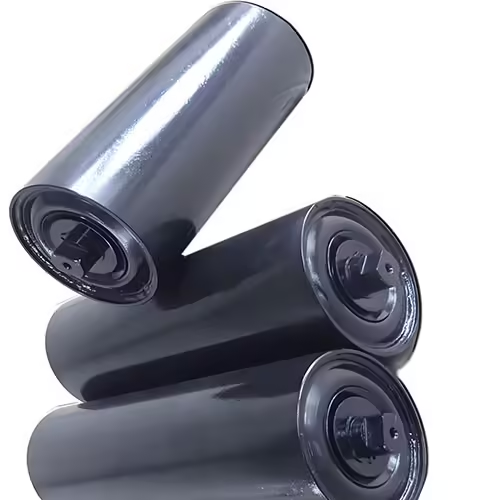
Even in highly automated factories, gravity conveyor systems remain widely used. The reason is simple: they are cost-effective, reliable, and easy to maintain.
When you use gravity conveyor rollers, you eliminate the need for motors in certain sections of your production line. This brings several benefits:
- Lower energy consumption
- Reduced system complexity
- Minimal maintenance requirements
- Faster installation time
- Flexible layout design
In real industrial environments, many companies use gravity rollers as buffer zones between powered conveyor sections. This helps regulate material flow without adding mechanical complexity.
Industry design studies show that hybrid systems combining powered conveyors with gravity roller sections can reduce operational energy usage by a noticeable margin while maintaining stable throughput.
How Gravity Conveyor Rollers Work in Your System
The working principle is straightforward but highly effective.
Gravity conveyor rollers rely on:
- Inclined conveyor layout
- Roller rotation with minimal friction
- Load weight as the driving force
When you place an object on the roller system, gravity pulls it forward along the inclined path. The rollers reduce friction, allowing smooth and controlled movement.
Unlike powered conveyors, there is no motor-driven force. Instead, system efficiency depends on:
- Roller quality
- Bearing smoothness
- Frame alignment
- Incline angle
Even small improvements in roller rotation efficiency can significantly improve material flow consistency.
Key Advantages You Can Expect from Gravity Conveyor Rollers
When properly designed, gravity conveyor systems offer multiple operational advantages.
1. Energy-Free Operation
Since no motor is required, the system operates without electricity. This makes it ideal for short-distance transport or staging areas.
2. Lower Maintenance Cost
With fewer mechanical parts, there is less risk of breakdown. You mainly maintain rollers and frame alignment.
3. Flexible System Design
You can easily extend or modify gravity conveyor sections without complex electrical redesign.
4. Smooth Material Buffering
Gravity rollers are often used as buffer zones in production lines to prevent congestion between processes.
5. Quiet Operation
Without motor noise, the system operates quietly, improving working conditions.
Where Gravity Conveyor Rollers Perform Best
Gravity roller systems are not designed for every application. They work best in controlled environments such as:
- Packaging lines
- Assembly stations
- Warehouse sorting systems
- Loading and unloading zones
- Buffer storage areas between machines
They are especially effective when:
- Load weights are moderate
- Flow direction is consistent
- System height difference can be designed
- High-speed transport is not required
Real Case Example: Warehouse Flow Optimization
To understand practical benefits, consider a warehouse distribution scenario.
Before using gravity conveyor rollers, material movement relied entirely on manual handling and powered conveyors. This created:
- Bottlenecks between processing stations
- High labor intensity
- Unstable material flow
- Frequent delays during peak hours
After introducing gravity roller lanes between key zones, the system improved significantly:
- Operators could move goods without lifting
- Transfer time between stations decreased
- Congestion points were reduced
- Labor efficiency increased
The most noticeable improvement was flow consistency. Instead of sudden stops and manual intervention, materials moved continuously between workstations.
Key Components That Affect Gravity Conveyor Performance
Even though gravity systems are simple, performance depends on several key components:
- Roller diameter and material
- Bearing quality and lubrication
- Frame rigidity and alignment
- Roller spacing design
- Incline angle of the system
Among these, roller quality is the most critical factor. Poor-quality rollers create resistance, which slows down material flow and reduces system efficiency.
Comparison: Gravity Conveyor vs Powered Conveyor
To help you understand when to use gravity systems, here is a practical comparison:
| Feature | Gravity Conveyor Rollers | Powered Conveyor Systems |
|---|---|---|
| Energy Usage | None | High |
| Maintenance Cost | Low | Medium to High |
| Speed Control | Limited | Precise |
| Installation Complexity | Simple | Complex |
| Flexibility | High | Medium |
| Ideal Usage | Buffer & transfer zones | Full transport lines |
This comparison shows that gravity systems are not replacements but complements to powered conveyors.
How You Should Design a Gravity Conveyor System
To get the best performance, you need to carefully design your system layout.
1. Optimize Incline Angle
Too steep causes uncontrolled speed; too flat stops movement. The correct angle depends on material weight and surface friction.
2. Select Proper Roller Material
Different environments require different roller materials:
- Steel rollers for heavy loads
- Coated rollers for corrosion resistance
- Lightweight rollers for packaging systems
3. Maintain Proper Roller Spacing
If spacing is too wide, items may sag or jam. If too close, friction increases.
4. Ensure Frame Stability
A rigid frame ensures smooth alignment and reduces vibration during movement.
Maintenance Practices for Long-Term Efficiency
Although gravity systems are low-maintenance, regular checks improve lifespan:
- Inspect roller rotation regularly
- Clean dust and debris from roller surfaces
- Check frame alignment
- Replace worn rollers promptly
- Ensure consistent incline angle
Neglecting maintenance can lead to uneven flow and system inefficiency over time.
Economic Value of Gravity Conveyor Rollers
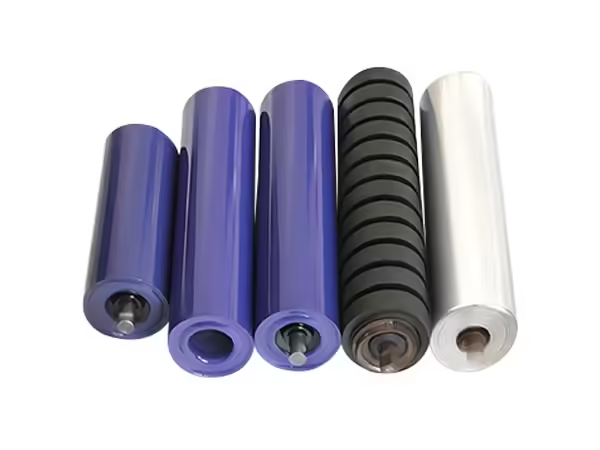
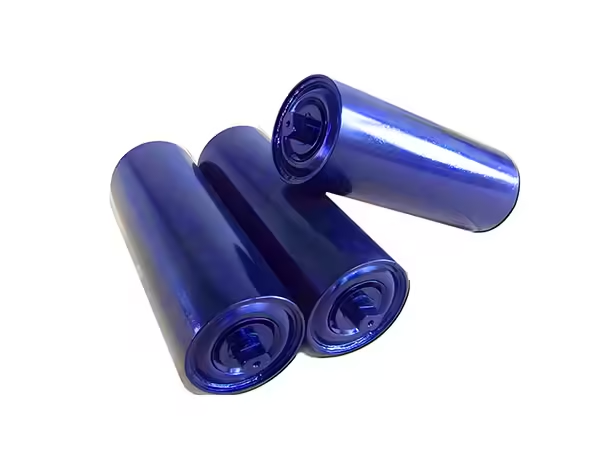
From a business perspective, gravity conveyor systems provide strong cost advantages:
- No energy consumption for movement
- Reduced motor dependency
- Lower installation cost
- Minimal spare part replacement
- Reduced operational downtime
In long-term operations, these savings accumulate significantly, especially in large-scale material handling environments.
Final Thoughts
Gravity conveyor rollers may look simple, but they play a powerful role in modern material handling systems. When designed correctly, they reduce operational cost, improve workflow efficiency, and provide a flexible solution for material transfer.
Instead of relying entirely on powered systems, integrating gravity-based sections can help you build a smarter, more efficient, and more balanced production line.
FAQ
What are gravity conveyor rollers used for?
They are used to transport materials using gravity without powered motors, mainly in warehouses and production lines.
Do gravity conveyor rollers need electricity?
No, they operate entirely through gravity and system incline.
Can gravity conveyors handle heavy loads?
Yes, if properly designed with strong rollers and correct spacing.
What industries use gravity conveyor rollers?
They are widely used in logistics, packaging, manufacturing, and assembly systems.
How do you control speed in gravity conveyors?
Speed is controlled by adjusting the incline angle and roller resistance.
Are gravity conveyor rollers suitable for long distances?
They are better suited for short to medium distances or as part of hybrid systems.
 English
  French
  Spanish