
In modern conveyor roller manufacturing, efficiency is no longer defined only by cutting speed or machine output. Instead, the real performance factor lies in machining consistency—especially when producing conveyor roller shafts that must meet strict alignment and dimensional accuracy requirements.
One of the most critical processes in this production chain is double-end flat milling of roller shafts. Any deviation in flatness, symmetry, or dimensional precision can directly affect roller assembly stability, bearing alignment, and long-term conveyor performance.
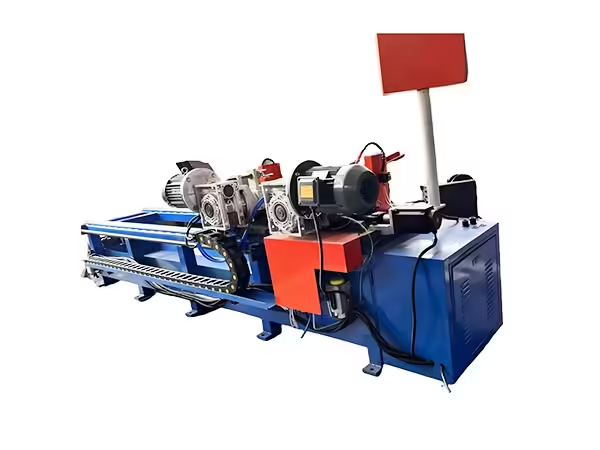
This is where the automatic conveyor roller shaft double-end through flat milling machine becomes essential. It is designed to ensure both ends of the shaft are processed simultaneously with high precision, improving consistency and dramatically reducing manual machining errors.
In this article, you will learn how this machine improves production efficiency, why a double-end milling machine is critical for conveyor roller manufacturing, and how automation reshapes modern shaft processing lines.
Table of Contents
Why Conveyor Roller Shaft Accuracy Matters More Than You Think
In conveyor systems, shafts are not just structural components—they are alignment cores.
Even minor machining errors can lead to:
- Bearing misalignment
- Uneven roller rotation
- Increased vibration in conveyor systems
- Premature seal and housing wear
- Reduced system lifespan
According to mechanical manufacturing standards referenced in industrial engineering resources such as , dimensional consistency in rotating shafts is critical for long-term mechanical stability.
In conveyor roller production, shaft accuracy directly determines final product reliability.
What Makes Double-End Milling Different from Traditional Shaft Machining
Traditional shaft machining methods typically process one end at a time, requiring multiple setups and repositioning.
This introduces several risks:
- Positioning deviation between operations
- Uneven surface flatness
- Increased labor involvement
- Lower production consistency
In contrast, a double-end milling machine processes both ends simultaneously in a single setup.
This ensures:
- Perfect symmetry between both shaft ends
- Reduced cumulative positioning errors
- Higher repeatability in mass production
- Faster cycle time per shaft
This is particularly important in conveyor roller production lines where thousands of shafts must maintain identical geometry.
How Automatic Milling Improves Conveyor Roller Manufacturing Efficiency
Automation is not just about reducing manual labor—it is about stabilizing production quality.
The automatic conveyor roller shaft double-end milling machine provides:
- PLC-controlled operation for process stability
- Automatic feeding system for continuous production
- Hydraulic or mechanical clamping for precision positioning
- Synchronized double-end machining for uniform results
Industry automation studies referenced in manufacturing insights show that automated machining systems significantly reduce dimensional variation in mass production environments.
Role of Shaft Milling in Conveyor Roller Production Lines
To understand its importance, you need to see where it fits in the production chain:
- Steel pipe preparation
- Shaft cutting and alignment
- Double-end milling (this machine stage)
- Bearing housing assembly
- Roller shell welding
- Sealing system installation
- Final assembly testing
This machining step ensures that every shaft entering assembly meets strict geometric standards.
You can explore related conveyor components here:
- Conveyor roller set system →
- Heavy duty conveyor rollers →
- Conveyor belt idlers →
Engineering Insight: Why Symmetry in Shaft Ends Is Critical
A conveyor roller shaft must maintain perfect symmetry because:
- Bearings require equal load distribution
- Misalignment causes uneven wear
- Vibration increases in high-speed rotation
- Seal performance depends on stable axis geometry
Even a small deviation between shaft ends can multiply across conveyor systems, especially in long-distance material handling lines.
A double-end milling machine eliminates this risk by ensuring both ends are machined under identical conditions in a single cycle.
Real Production Scenario: Conveyor Roller Shaft Manufacturing Line
In a typical conveyor roller manufacturing facility, inconsistent shaft machining often causes:
- Assembly delays due to rework
- Increased scrap rate
- Bearing misfit issues
- Roller vibration during testing
After introducing automatic double-end milling systems, production changes significantly:
- Shaft consistency improves across batches
- Assembly line errors decrease
- Roller rotation becomes smoother
- Rework rates drop noticeably
- Overall production flow becomes more stable
The most important improvement is not just speed—it is standardization.
Why Automation Is Reshaping Conveyor Roller Production
Modern manufacturing is shifting toward automation due to:
- Demand for higher precision
- Increased production volume requirements
- Need for reduced human error
- Standardization across global supply chains
Automation ensures that every shaft meets identical machining parameters, regardless of production volume.
This trend is widely discussed in industrial manufacturing communities and engineering forums such as .
Key Technical Advantages of Double-End Milling Machines
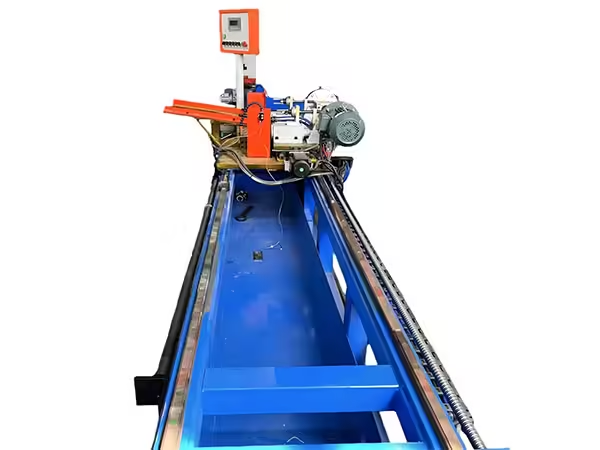
When evaluating this type of double-end milling machine, key engineering advantages include:
- Synchronous dual-end machining
- High repeat positioning accuracy
- Stable hydraulic or pneumatic clamping
- PLC-based control system
- Reduced machining cycle time
- Improved surface flatness consistency
These features collectively improve production line efficiency and product uniformity.
Installation and Operation Considerations
To ensure optimal performance of the milling machine, you should:
- Ensure stable foundation installation
- Maintain hydraulic system pressure stability
- Calibrate alignment before production
- Use consistent raw material dimensions
- Perform periodic tooling inspection
Proper setup ensures long-term machining consistency.
Maintenance Strategy for Long-Term Machine Stability
Even automated systems require structured maintenance:
- Lubricate moving components regularly
- Inspect cutting tools for wear
- Check hydraulic system performance
- Monitor PLC system signals
- Clean machining residue buildup
Preventive maintenance ensures continuous production efficiency.
Industrial Value: Why This Machine Improves ROI
From a production engineering perspective, this machine improves ROI by:
- Reducing machining errors
- Increasing production speed
- Lowering labor dependency
- Improving product consistency
- Reducing scrap and rework rates
In conveyor roller manufacturing, consistency is directly linked to downstream system reliability.
Final Thoughts
The automatic conveyor roller shaft double-end through flat milling machine is not just a machining tool—it is a production consistency system. By ensuring symmetrical, high-precision machining of both shaft ends in a single process, it eliminates variability and strengthens the foundation of conveyor roller manufacturing.
FAQ
What is an automatic conveyor roller shaft double-end through flat milling machine used for?
It is used to machine both ends of conveyor roller shafts simultaneously for high precision and symmetry.
Why is shaft milling important in conveyor rollers?
Because shaft accuracy directly affects bearing alignment and roller stability.
Does automation improve machining accuracy?
Yes, automation reduces human error and improves consistency in mass production.
Can this automatic conveyor roller shaft double-end through flat milling machine be used for high-volume production?
Yes, it is specifically designed for continuous and batch production environments.
What causes shaft machining errors?
Common causes include misalignment, manual repositioning, and inconsistent clamping.
How does it improve conveyor system performance?
By ensuring uniform roller shaft quality, it improves overall conveyor stability and reduces vibration.
 English
  French
  Spanish