
Table of Contents
Introduction
If your factory cuts tubes, pipes, or roller components every day, the cutting process is not just a simple preparation step. It directly affects welding quality, assembly accuracy, production speed, material waste, and final product consistency.
A cnc saw machine helps you move from manual cutting to a more controlled, repeatable, and efficient production process. For tube processing factories, conveyor roller manufacturers, metal fabrication workshops, and machinery plants, the right equipment can reduce cutting errors, improve workflow stability, and make batch production easier to manage.
However, choosing a cnc saw machine is not only about cutting speed. You also need to consider tube diameter, wall thickness, material type, feeding accuracy, clamping stability, cutting surface quality, safety design, maintenance access, and supplier support.
This guide explains how to choose the right cnc saw machine for accurate tube cutting and long-term industrial use.
Why Choosing the Right CNC Saw Machine Matters
Many factories start with manual cutting because it seems simple and flexible. For small quantities, this may work. But when production volume increases, manual cutting often creates problems.
Operators may measure differently. Tubes may shift during cutting. Cutting lengths may vary from batch to batch. Burrs may increase finishing work. Downstream processes such as welding, pressing, drilling, or assembly may become harder to control.
A cnc saw machine solves many of these issues by turning cutting into a programmed and repeatable process. Instead of relying on manual measurement for every piece, the machine controls feeding, positioning, clamping, and cutting according to set parameters.
For industrial production, this means better consistency, fewer unnecessary adjustments, and a smoother workflow from cutting to final assembly.
What Is a CNC Saw Machine?
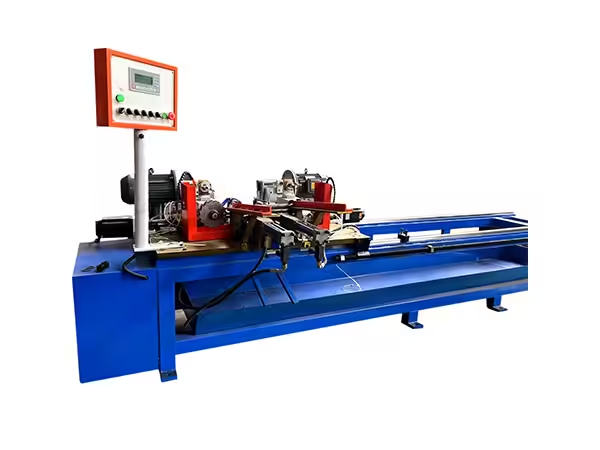
A cnc saw machine is an automated cutting machine that uses computer numerical control to manage the cutting process. It is commonly used to cut metal tubes, pipes, profiles, or similar materials into fixed lengths.
Unlike a manual saw, a cnc saw machine can follow programmed cutting lengths and repeat the same operation many times with less variation. This makes it useful for factories that need stable batch production.
Basic Working Principle
A typical cnc saw machine follows a simple production logic:
The operator enters cutting parameters.
The feeding system moves the tube to the required length.
The clamping system holds the material securely.
The cutting unit completes the cut.
The finished piece is discharged or moved to the next process.
This controlled process reduces the risk of human error and improves repeatability during long production runs.
Where It Fits in Industrial Production
A cnc saw machine is often used before welding, machining, roller assembly, frame fabrication, or other downstream operations. If the tube is cut inaccurately, the next process becomes more difficult.
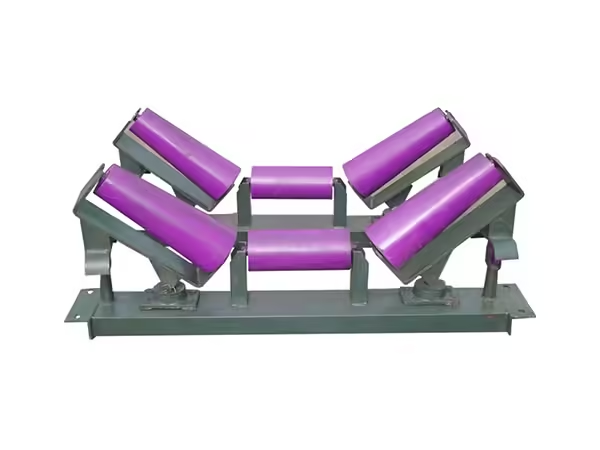
For example, in conveyor roller production, tube length affects bearing installation, shaft alignment, roller balance, and final assembly quality. That is why cutting accuracy is not a small detail. It is part of overall product quality control.
In production lines where fixed-length tube sections are required, an automatic tube cutting machine can help connect cutting accuracy with later assembly efficiency.
How a CNC Saw Machine Works
Although machine designs may vary, most cnc saw machines include feeding, clamping, cutting, control, and discharge systems. Each part affects cutting performance.
Material Loading and Clamping
The tube is placed into the feeding area and positioned for cutting. During the cutting process, stable clamping is essential.
If the tube moves, vibrates, or tilts, the cut length and end-face quality may become unstable. Strong clamping helps keep the material in place and reduces the risk of angled cuts, burrs, and surface defects.
Hydraulic clamping is often used in industrial cutting equipment because it provides stable holding force. For round tubes, self-centering structures can also help improve alignment.
Servo Feeding and Positioning
The feeding system determines how accurately the material moves to the cutting position. In a CNC-controlled machine, servo feeding is commonly used to improve positioning control and repeatability.
A stable feeding system helps the machine cut multiple pieces to the same length. This is especially important when the parts will be used in assembly lines, conveyor rollers, mechanical frames, or precision structures.
When comparing machines, do not only ask how fast the saw can cut. You should also ask how the feeding system controls length accuracy.
Cutting and Discharge
After feeding and clamping, the cutting unit performs the cut. The cutting quality depends on tool condition, machine rigidity, material type, cutting speed, feed rate, and clamping stability.
Once the cut is complete, the finished section is discharged or moved forward for the next operation. In a well-designed production workflow, cutting should not become a bottleneck for welding, assembly, or packaging.
Key Benefits of Using a CNC Saw Machine
A cnc saw machine brings value not only because it cuts material, but because it improves the entire cutting workflow.
Better Cutting Consistency
Consistency is one of the biggest advantages of CNC cutting equipment. Once the machine is set correctly, it can repeat the same cutting length over many cycles.
This is important when your factory produces parts that must fit into a larger assembly. Even small cutting differences can create problems later, especially in roller production, equipment frames, or welded structures.
Reduced Labor Dependency
Manual cutting depends heavily on operator experience. A skilled worker may produce good results, but consistency can still vary during long shifts.
A cnc saw machine reduces manual measuring and repeated repositioning. Operators still need training, but the machine helps them maintain stable output with less physical effort.
Improved Production Rhythm
In a busy workshop, unstable cutting can slow down the entire line. If the cutting station cannot supply accurate parts on time, the next process may need to wait.
A CNC-controlled cutting process creates a more predictable rhythm. This helps production managers plan output, reduce rework, and improve delivery stability.
Cleaner Cutting and Less Rework
When the machine is properly selected and maintained, it can produce cleaner cuts with fewer burrs. This reduces the need for secondary finishing and helps improve the efficiency of downstream processes.
Cut quality depends on many factors, including blade condition, material hardness, wall thickness, cutting speed, and clamping strength. In practical metal tube cutting applications, the machine structure and cutting parameters need to work together to maintain a stable finish.
CNC Saw Machine vs Manual Saw vs Semi-Automatic Saw
The right cutting method depends on production volume, accuracy requirements, labor cost, and workflow needs.
| Cutting Method | Best For | Main Advantages | Common Limitations |
|---|---|---|---|
| Manual saw | Small batches and occasional cutting | Flexible and simple to operate | Lower efficiency, more operator-dependent, less stable accuracy |
| Semi-automatic saw | Medium-volume production | Better than manual cutting, easier operation | Still requires more manual positioning and monitoring |
| CNC saw machine | Batch production and accurate tube cutting | Programmable feeding, repeatable cutting, better production stability | Requires correct setup, training, and regular maintenance |
| Advanced profile cutting system | Complex shapes and special cutting requirements | Suitable for shaped or irregular cutting | May require more complex operation and process planning |
If your workshop only cuts a few simple parts occasionally, manual equipment may be enough. If you need stable output, fixed-length cutting, and better batch consistency, a cnc saw machine is usually the better choice.
Main Applications of CNC Saw Machines
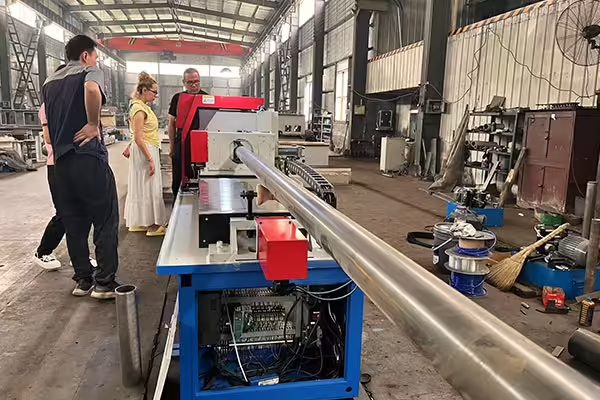
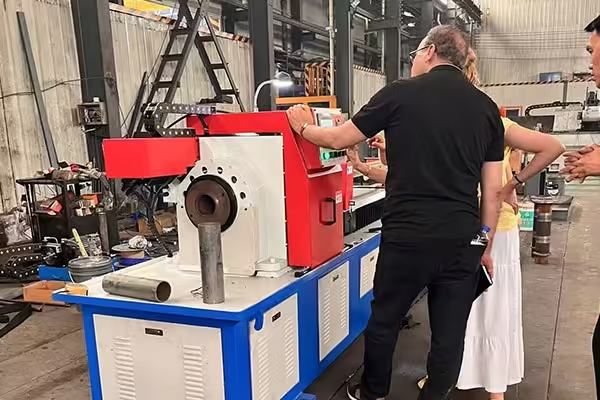
A cnc saw machine is suitable for many industrial cutting applications, especially where repeated cutting accuracy is required.
Conveyor Roller Production
Conveyor roller production often requires steel tubes to be cut into accurate lengths before shaft assembly, bearing housing installation, welding, or pressing.
If the tube length is unstable, roller assembly becomes harder to control. A cnc saw machine helps improve consistency before the next production step.
Metal Tube Processing
Metal tube processing workshops use cnc saw machines to cut carbon steel tubes, stainless steel tubes, aluminum tubes, and other industrial tube materials.
The correct machine configuration depends on tube diameter, wall thickness, material hardness, and required cutting surface quality.
Machinery Fabrication
Machinery factories often cut tubes and profiles for frames, supports, equipment bases, conveyor systems, and structural parts.
A cnc saw machine helps prepare these materials more accurately, which makes welding and assembly easier.
Batch Cutting for Industrial Parts
When a factory needs hundreds or thousands of pieces with the same length, CNC feeding becomes very useful. Instead of measuring each piece manually, the machine repeats the programmed cutting cycle.
This improves efficiency and reduces variation between batches.
Key Specifications to Check Before Buying
Before choosing a cnc saw machine, you should define your actual production requirements. A machine that works well for one factory may not be suitable for another.
Tube Diameter and Wall Thickness
Start with your material range. You need to know the minimum and maximum tube diameter, wall thickness, and material type.
Do not select a machine only based on your current most common size. If your factory may process larger or thicker tubes in the future, discuss this with the supplier in advance.
Cutting Length and Repeatability
Cutting length range tells you what size parts the machine can produce. Repeatability tells you how consistently the machine can return to the same cutting length.
For high-volume tube cutting, repeatability is often more important than one-time accuracy. The machine must perform consistently over many cycles.
Clamping and Feeding Structure
Clamping affects cutting stability. Feeding affects length accuracy. These two systems are central to CNC saw performance.
When evaluating a machine, ask about the feeding method, guide structure, clamping force, positioning control, and how the machine handles different tube sizes.
Control System and Operation Interface
A good control system should be easy to understand and practical for daily production. Operators should be able to set cutting length, adjust parameters, check machine status, and respond to alarms without confusion.
A complicated interface can reduce efficiency, especially when new operators need training.
How to Evaluate Cutting Accuracy and End-Face Quality
Cutting accuracy is not only determined by the control system. It depends on the whole machine structure and cutting process.
You should evaluate:
Feeding accuracy
Clamping stability
Machine rigidity
Tool sharpness
Tube straightness
Material hardness
Cutting speed
Operator setup
Vibration control
End-face quality is also important. A good end face should be flat, clean, and suitable for the next process. If the cut produces too many burrs or deformation, the factory may need extra deburring or finishing work.
For production lines that require assembly or welding, cutting quality should always be checked together with downstream process requirements.
Safety and Compliance Considerations
A cnc saw machine includes moving parts, clamping devices, cutting tools, and electrical controls. Safety should be part of the machine selection process.
You should check whether the machine includes proper guarding, emergency stop buttons, safe tool access, clear operating procedures, and operator protection around the cutting area.
In machinery design and factory operation, ISO 12100 machinery safety is often used as an important reference for risk assessment and risk reduction, especially when equipment includes cutting motion, clamping force, and operator access areas.
Even if safety regulations differ by country or region, the basic principle is the same: operators should be protected from moving parts, cutting points, flying chips, and unexpected machine movement.
Maintenance Tips for Long-Term Machine Performance
A cnc saw machine needs regular maintenance to keep cutting accuracy and production stability. Maintenance should not be treated only as repair work. It should be part of daily quality control.
Daily Inspection
Before production starts, operators should check the cutting tool, clamping system, lubrication status, emergency stop function, and visible machine condition.
Any abnormal sound, vibration, or movement should be checked early.
Cutting Tool Maintenance
A worn cutting tool can cause burrs, heat, noise, vibration, and poor end-face quality. Tool condition should be checked regularly according to production volume and material type.
Replacing or sharpening tools at the right time helps maintain cutting performance.
Feeding System Cleaning
Guide rails, screws, and feeding components should be kept clean. Chips, dust, and debris can affect movement accuracy over time.
Lubrication should also follow the supplier’s maintenance instructions.
Hydraulic and Pneumatic Checks
If the machine uses hydraulic or pneumatic systems, operators should check pressure stability, oil leakage, air leakage, cylinder movement, and hose condition.
Unstable clamping pressure can reduce cutting accuracy and create safety risks.
Scheduled Maintenance
Factories should create a maintenance schedule for mechanical, electrical, hydraulic, and control systems. A simple checklist can prevent small issues from becoming serious downtime problems.
How to Choose a Reliable CNC Saw Machine Supplier
Choosing the right supplier is just as important as choosing the machine itself. A cnc saw machine is part of your production system, so technical support matters.
A reliable supplier should understand your material, tube size, production volume, accuracy requirement, and downstream process. They should also be able to explain the machine structure clearly and recommend a suitable configuration.
Before confirming a machine, ask whether the supplier can provide:
Technical consultation
Machine configuration advice
Operator training guidance
Maintenance support
Spare parts support
Customization options
Clear communication after delivery
A good supplier should not only sell a machine. They should help you match the equipment to your real production process.
Common Mistakes to Avoid Before Purchase
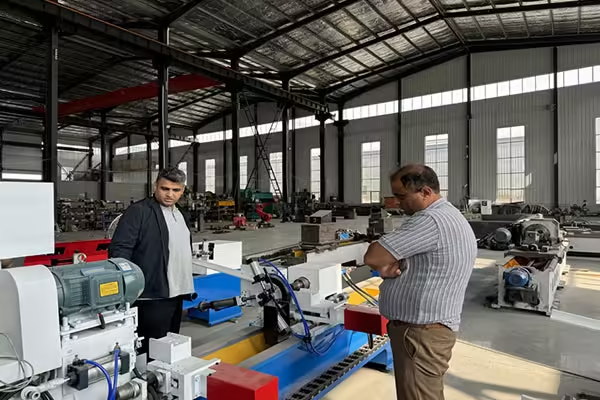
Many purchasing problems happen because the factory does not prepare enough technical information before asking for a quotation.
Only Focusing on Cutting Speed
Cutting speed is important, but speed without stability is not useful. If the machine cuts quickly but produces inaccurate lengths or poor surfaces, rework will reduce the real efficiency.
Ignoring Material Differences
Different materials behave differently during cutting. Carbon steel, stainless steel, and aluminum may require different cutting tools, speeds, and machine settings.
Underestimating Clamping Stability
Weak clamping can cause vibration, angled cuts, and poor end quality. Clamping should always be checked carefully when comparing machines.
Forgetting Downstream Processes
Cutting should support the next step. If the tube will be welded, pressed, assembled, or machined, the cutting quality must match those requirements.
Sending an Incomplete Inquiry
To get a better recommendation, you should provide tube material, diameter range, wall thickness, required cutting length, production volume, accuracy needs, end-face requirements, workshop space, and downstream process.
The more complete your information is, the easier it is for the supplier to recommend a suitable cnc saw machine.
Conclusion
A cnc saw machine is not just a cutting tool. It is a production stability tool.
For factories that need accurate tube cutting, repeatable batch output, lower labor dependency, and smoother downstream processing, CNC-controlled saw equipment can bring real value.
The best machine should match your actual tube size, material type, wall thickness, production volume, accuracy requirement, and workshop workflow. Before buying, pay close attention to feeding accuracy, clamping structure, cutting quality, safety design, maintenance access, and supplier support.
When selected correctly, a cnc saw machine can help your factory build a more efficient, reliable, and scalable cutting process.
FAQ
What is a cnc saw machine used for?
A cnc saw machine is used to cut tubes, pipes, profiles, or similar materials into accurate lengths through programmed feeding, clamping, and cutting. Because it follows the same basic logic as computer numerical control, it is especially useful for batch production where stable length, cleaner end faces, and reduced manual measurement errors are important.
How does a cnc saw machine improve cutting accuracy?
A cnc saw machine improves accuracy by controlling feeding length, clamping force, and cutting movement through programmed settings. Compared with manual cutting, it reduces operator-dependent variation and helps maintain more consistent results during repeated production cycles.
What materials can a cnc saw machine cut?
A cnc saw machine can be configured to cut carbon steel tubes, stainless steel tubes, aluminum tubes, and other industrial tube materials. The suitable material range depends on machine structure, cutting tool type, motor power, clamping design, and cutting parameters.
Is a cnc saw machine suitable for small factories?
Yes. A cnc saw machine can be suitable for small and medium factories if they need repeated tube cutting, stable lengths, or lower labor dependency. The key is to choose a machine that matches actual tube size, production volume, floor space, and operator capability.
What should I provide when requesting a cnc saw machine solution?
You should provide tube material, outer diameter, wall thickness, required cutting length, production volume, accuracy requirement, end-face quality needs, available workshop space, power supply, and the next production process after cutting. This helps the supplier recommend the right configuration.
 English
  French
  Spanish