
Welcome to My Blog!
Before we dive into the content, I’d love for you to join me on my social media platforms where I share more insights, engage with the community, and post updates. Here’s how you can connect with me:
Facebook:https://www.facebook.com/profile.php?id=61578855814440
Now, let’s get started on our journey together. I hope you find the content here insightful, engaging, and valuable.
Table of Contents
In industrial production, precision and efficiency are no longer luxuries — they are necessities. If you are responsible for a fabrication line, piping workshop, or metal processing facility, you know the challenge of achieving consistent, accurate tube cuts while maintaining throughput and minimizing waste. Automated tube cutting machine has emerged as a transformative solution, combining advanced automation, precision control, and high-speed processing to address these needs.
In this comprehensive guide, you will learn how automated tube cutting machine works, its key benefits, how to choose the right system, and practical insights from real-world applications. We also include detailed comparisons, maintenance advice, and a FAQ section to make this guide genuinely useful for your operations.
What Is Automated Tube Cutting Machine?
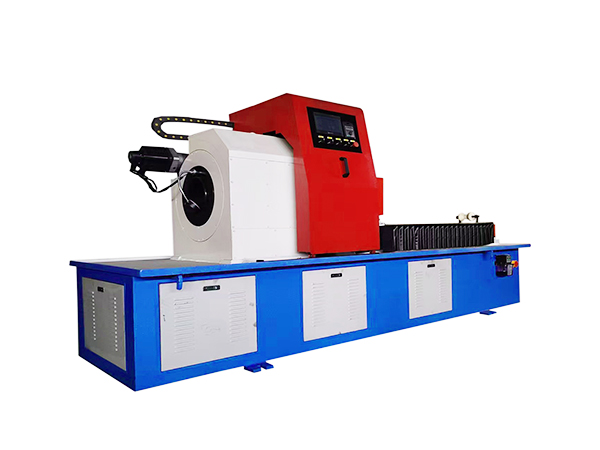
Automated tube cutting machine refers to industrial systems that use programmable controls and mechanical or laser cutting technology to cut tubes and pipes accurately and repeatedly. Unlike manual approaches or semi-automatic tools, these machines integrate cutting, feeding, and measurement processes into a seamless workflow. This level of automation greatly reduces manual labor and variability in cut quality.
In a typical automated system:
- A programmable interface (often PLC or CNC) allows you to input multiple cut lengths and batch instructions.
- Servo-driven or motorized rollers feed tubes automatically.
- The cutting mechanism (laser, blade, or jet) executes precise cuts at programmed lengths.
- Finished parts are discharged automatically.
This integrated workflow is ideal for high-volume, high-precision production environments where consistency and speed matter.
For a deeper look at the technologies behind these systems, check out automated tube cutting machines overview.
How Automated Tube Cutting Machine Works
Understanding the mechanics helps you appreciate why automated systems outperform traditional alternatives:
- Tube Loading: Tubes are loaded either manually or by a conveyor/robotic arm.
- Length Programming: You enter target lengths and batch parameters via the control panel.
- Material Feeding: Servo motors feed tubes steadily into the cutting area.
- Cutting Action: Depending on the machine type, the system uses:
- Laser Cutting: Precise, burr-free results with minimal heat-affected zones.
- Rotary Blade Cutting: Fast material separation for routine cuts.
- Water Jet Cutting: Cuts without heat for sensitive or thick materials.
- Post-Cut Handling: Finished tubes are sorted or transported for further processing.
- Quality Feedback: Some machines include inline measurement and quality checks that adjust for tolerance drift in real time.
To explore how these systems differ by technology, see tube cutting technology comparison.
Types of Automated Tube Cutting Machine
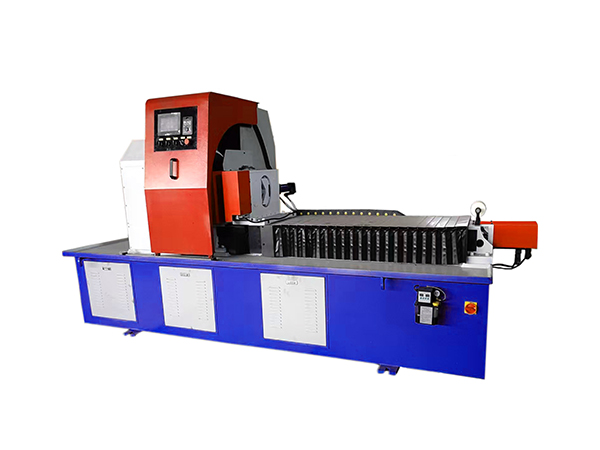
There are several configurations of automated tube cutting systems, and choosing the right one depends on application needs:
Laser-Based Tube Cutters
These systems use high-intensity laser beams for cutting. They offer:
- Extremely high precision
- Minimal burr formation
- Excellent surface finish
Laser cutters are ideal for fabrications requiring very tight tolerances.
Servo Blade Tube Cutters
Servo blade machines use a rotating cutter head driven by precision motors. They are:
- Fast and efficient for high-volume runs
- Effective for standard metals like steel and aluminum
- Less costly than laser options for basic cutting requirements
Water Jet Tube Cutters
Water jets cut tubes using a high-pressure stream of water combined with an abrasive medium. Benefits include:
- No heat deformation
- Capability to cut thick or composite materials
- Smooth edge profiles suitable for sensitive applications
Each cutting method has its place depending on materials, throughput, and finish requirements.
Key Components of Automated Tube Cutting Machine
To understand how automation improves performance, let’s examine the core elements:
Control System
The heart of the machine is the PLC or CNC controller. This interface allows you to:
- Set cut lengths and tolerance limits
- Store multiple programs for different production runs
- Automatically switch cutting sequences
A powerful control system reduces setup time and operator error.
Feeding Mechanism
Materials are fed into the cutting station using motorized rollers or conveyors. Precision feeding systems ensure:
- Consistent cut length accuracy
- Reduced tube slippage
- Higher throughput
Servo-controlled feeding systems often outperform basic stepper motors in high-speed environments.
Cutting Head
Depending on your choice (laser, blade, water jet), the cutting head is where the material is separated. Advanced machines include:
- Auto-focus lasers
- Quick-change blade assemblies
- Adjustable beam shape for different geometries
These features enhance versatility across tube diameters and wall thicknesses.
Safety and Monitoring
Automated equipment includes safety interlocks, shielded cutting areas, emergency stops, and sensor feedback for protective operation. Modern systems may also integrate monitoring for vibration, blade wear, or laser consistency.
Benefits of Automated Tube Cutting Machine
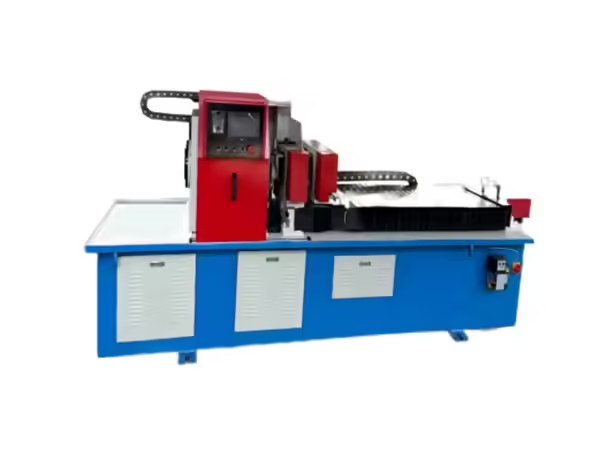
Let’s explore the key advantages that make automation worthwhile for manufacturers.
1. Higher Productivity
Automation speeds up production dramatically compared to manual or semi-automatic cutting. By eliminating operator intervention for every cut, you achieve uninterrupted throughput and consistent cycle times.
According to industry data on automatic tubing cutters, automated systems can cut up to 4 times faster than manual methods while maintaining precision. This leads to significant increases in parts per hour and reduces bottlenecks in your fabrication line.
Source: automatic tubing cutters market insights
2. Consistent Cutting Quality
Automated systems deliver repeatable results with minimal variation. Precision is especially important for downstream processes like welding or assembly where misalignment or variations can cause costly rework.
Tolerance levels in automated tube cutting often achieve ±0.1 mm repeatability in industrial environments. This level of accuracy translates into less scrap and higher product quality.
3. Reduced Material Waste
Consistent cuts minimize over-length allowances that typically occur in manual cutting. When you reduce waste, you lower material costs directly.
High-precision cutting systems also produce fewer chips and dross, meaning less cleaning and secondary finishing are needed.
4. Labor Cost Savings
By reducing manual cutting tasks, you free operators to handle higher-value activities like quality control, maintenance, and programming. This is especially valuable in facilities with high turnover or skill shortages.
5. Enhanced Safety
Automated systems greatly reduce operator exposure to sharp edges, spinning blades, or high-energy beams. Fully enclosed systems with safety interlocks prevent access during cutting cycles.
Real-World Case: Automated Tube Cutting Machine in Action
To illustrate the practical impact of automation, here are two industry case studies.
Case Study 1: Automotive Component Manufacturer
A supplier for automotive exhaust systems struggled with manual cut inconsistencies that led to assembly misalignment and higher defect rates. With automated tube cutting machine installed:
- Production throughput increased by 38%
- Defect rates due to incorrect lengths dropped by 72%
- Labor hours spent on cutting operations decreased by 61%
The return on investment was achieved within 9 months due to increased efficiency and reduced waste.
Case Study 2: HVAC Fabrication Shop
An HVAC ductwork shop needed to cut a variety of tube diameters for a large project. Manual cutting caused bottlenecks and inconsistent joint fits. After implementing an automated solution:
- Average cut cycle times decreased by 45%
- Repeatability improved, reducing post-processing needs
- Lead times for customization reduced significantly
Both cases demonstrate how automation solves key pain points and improves throughput.
How to Choose the Right Machine for Your Operation
When evaluating automated tube cutting machine, consider the following:
Production Volume
High-volume production benefits more from fully automated systems with integrated conveyors. Small batch or prototype work may be suited for flexible CNC machines.
Material Types
The metal you cut — steel, stainless steel, aluminum, copper, titanium, composites — should influence your choice. Laser systems excel with a broad range of materials, while rotary blade systems are ideal for high-speed straight cuts.
Cut Precision vs. Speed
If tolerances are critical, prioritize laser or water jet systems. If speed is the priority for standard geometry, high-speed blade systems are often more cost-effective.
Integration with Other Systems
Consider whether the machine needs to integrate with conveyors, robotic arms, or MES systems for tracking and ERP data synchronization.
Service and Support
Long-term uptime depends on reliable technical support, parts availability, and training. Evaluate vendors based on service reach and response times.
Automated Tube Cutting Machine Comparison Table
The following table helps you compare common machine types based on key parameters:
| Technology Type | Precision (± mm) | Typical Speed | Material Compatibility | Best Use Case |
|---|---|---|---|---|
| Laser Cutting | ±0.1 | Medium | Steel, Aluminum, Fiber Composites | High-precision parts, complex geometry |
| Rotary Blade | ±0.2 | High | Steel, Aluminum, Soft Metals | High-volume straight cuts |
| Water Jet | ±0.2–0.3 | Low–Medium | Thick Metals, Heat-sensitive | Thick tubing, no heat distortion |
| CNC-driven Saw | ±0.5 | High | General metal profiles | Bulk cuts with less finish requirement |
Maintenance Best Practices
To keep your automated tube cutting machine running efficiently:
Regular Cleaning
- Remove chips, dust, and debris after every shift
- Clean laser lenses or blade surfaces appropriately
Calibration
- Check alignment and feed accuracy weekly
- Recalibrate after maintenance
Lubrication
- Apply the grease and lubricant schedule recommended in the machine manual
- Focus on bearings, rollers, and linear guides
Software Updates
- Update control software to fix bugs, optimize performance, and add features
Well-maintained machines avoid unexpected downtime and extend component life.
Common Challenges and Solutions
Training Operators
Issue: Operators unfamiliar with automation may misuse the system.
Solution: Structured training programs and intuitive control panels reduce errors.
High Initial Investment
Issue: Automation can require substantial upfront costs.
Solution: Consider ROI through labor savings, waste reduction, and faster throughput.
Material Variability
Issue: Different materials require unique cutting parameters.
Solution: Machines with programmable profiles help switch between materials easily.
Conclusion
Automated tube cutting machines are transforming modern manufacturing by combining precision, speed, and automation. By integrating advanced feeding systems, laser or rotary cutting technologies, and intelligent control software, these machines reduce labor costs, minimize waste, and ensure consistent high-quality cuts. Real-world applications across automotive, HVAC, and metal fabrication industries demonstrate measurable improvements in productivity and efficiency. Investing in the right automated tube cutting system, combined with regular maintenance and operator training, allows you to maximize ROI while keeping your production line safe, reliable, and competitive. Whether you are looking to scale up production or improve cutting accuracy, embracing automation is a strategic step toward future-proofing your operations.
FAQ
What industries typically use automated tube cutting machine?
Industries such as automotive, aerospace, HVAC, medical device manufacturing, and general metal fabrication benefit from precise, high-speed tube cutting.
Can automated tube cutting machines handle different material types?
Yes. Modern systems often handle steel, stainless steel, aluminum, copper, titanium, and even composites based on cutting technology.
How much maintenance does automated equipment require?
With proper preventive schedules, automated tube cutting machines require routine cleaning, calibration, lubrication, and occasional software updates.
Are automated tube cutting machines safe to operate?
When equipped with safety interlocks, enclosed cutting zones, and emergency stops, these machines significantly reduce operator risk.
How precise are automated tube cutting systems?
High-quality laser systems often deliver precision within ±0.1 mm, far surpassing manual cutting methods.
 English
  French
  Spanish